
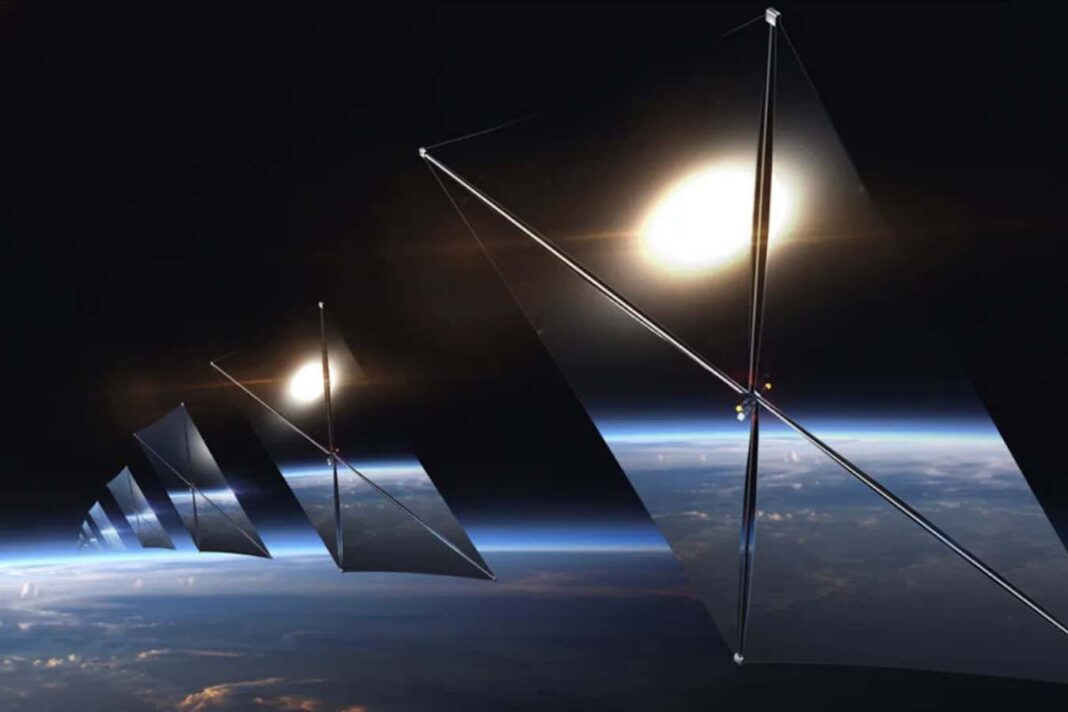


A constellation of 4,000 satellites bouncing sunlight back to Earth after dusk is no longer a scene confined to speculative novels. A consortium of aerospace engineers and private investors has formally unveiled the initiative, code-named “Solaria,” and intends to begin regulatory filings within months.
The Concept: Reflected Sunlight from Space
Solaria’s design relies on lightweight, steerable mirrors folded inside standard CubeSat buses. Once in 550-kilometre orbit, each mirror unfurls to 20 m² and tracks the Sun with MEMS-actuated panels, redirecting a narrow beam of light toward pre-selected ground corridors roughly 10 km wide. Operators claim that a single satellite can deliver about 10 lux—comparable to a bright full moon—while a squadron of 40 working in concert could reach 50 lux, enough to read a newspaper without additional electricity.
The pitch is straightforward: replace or supplement street lighting during peak evening hours, shave municipal power bills, and reduce the upward scatter that drowns out starlight. Cities along high-latitude routes where winter nights are longest are being courted first; remote mining sites and disaster zones are also on the early-adopter list. The hardware borrows from existing laser-communication satellites and Mylar solar-sail demonstrators, but scaling to 4,000 units would still demand a new, dedicated launch cadence—roughly 30 Falcon-9-equivalent missions.
Potential Applications: From Urban Planning to Entertainment
Urban-planning departments in Copenhagen and Calgary—both cities that already dim streetlights after midnight—have requested feasibility studies. If the reflected beams can be modulated on millisecond timescales, lighting designers see a new palette: synchronized “cold fireworks” for festivals or low-glare illumination for ski marathons that currently rely on diesel generators. Event promoters are exploring ticketed satellite-lit outdoor concerts where the light curve is choreographed to music.
Yet astronomers warn that even targeted beams raise diffuse sky-glow once the light scatters off atmospheric molecules. The International Dark-Sky Association estimates that a 4,000-sat fleet could add 8–12 % to natural night-sky brightness at observatory latitudes, complicating wide-field surveys such as the Vera C. Rubin Observatory.
Concerns and Criticisms: The Dark Side of Solaria
Orbital-debris analysts calculate that maintaining 4,000 satellites below 600 km would require at least 95 % reliability or an active de-orbit plan; otherwise the region could gain hundreds of long-lived fragments. Nocturnal ecologists cite studies showing that even 5 lux can disorient migrating birds and sea-turtle hatchlings. Meanwhile, insurers question liability if a mis-aimed beam momentarily dazzles pilots or highway drivers.
The consortium counters that each mirror is rimmed with a fail-safe shutter that closes within 200 ms if attitude sensors detect drift beyond 0.1°. They also promise to reserve a nightly “dark window” between 22:00 and 02:00 UTC for astronomy. Whether regulators will accept these concessions remains uncertain.
Environmental Concerns and Unintended Consequences
Beyond light, independent researchers worry about cumulative launch emissions. Thirty dedicated launches would deposit roughly 3,200 t of CO₂ into the upper atmosphere, offsetting several years of the program’s touted energy savings unless rockets switch to methane-oxygen or hydrogen-oxygen cycles. Radiative-forcing models further suggest that large reflective surfaces could alter local stratospheric temperatures by a few hundredths of a degree—small, but not yet studied at fleet scale.
| Potential Environmental Impact | Description |
|---|---|
| Disruption of nocturnal animal habitats | Changes to natural behavior, migration patterns, and population dynamics |
| Increased light pollution | Potential for increased sky-glow in certain regions |
| Interference with astronomical observations | Possible disruption of wide-field telescope surveys |
Economic and Social Implications
Preliminary tariffs shared with city councils range from €0.04 to €0.06 per kilolumen-hour—undercutting LED street lighting in regions where electricity exceeds €0.15 per kWh. Yet upfront capital is steep: ground beacons, control hubs, and insurance add an estimated $3.4 billion over the first five years. Critics argue the same capital could retrofit 60 million existing luminaires to Dark-Sky-compliant LEDs for comparable energy savings without orbital risk.
Equity questions also loom. Early contracts target affluent Nordic cities, while off-grid villages that stand to benefit most lack capital for ground infrastructure. The consortium has floated a subsidy model financed by carbon-credit sales, but verification standards for space-based illumination remain undefined.
Regulatory Hurdles and the Path Forward
Because reflected sunlight occupies no radio spectrum, the ITU has no direct mandate; instead, national regulators must weigh obligations under the Outer Space Treaty and the 2019 UN Guidelines for the Long-term Sustainability of Outer Space Activities. The U.S. Federal Communications Commission has already requested an environmental-impact statement for the first 100-satellite pathfinder batch. Approval timelines stretch into 2026, giving opponents time to press for an independent cost-benefit review.
Next milestones include a 50-satellite demonstration in late 2025, followed by public luminance measurements vetted by the European Southern Observatory. If data show beams can be kept below 2 % of natural sky brightness at 30° elevation, the full constellation request will proceed; otherwise the project may pivot to niche applications such as disaster-relief lighting only.
Whatever the outcome, Solaria has forced planners, ecologists, and insurers to confront a new category of anthropogenic light—one that arrives not from bulbs on the ground but from mirrors racing overhead at 7.8 km per second. The coming regulatory decisions will set precedents for how, and whether, Earth’s night sky becomes a managed resource in the 21st century.