
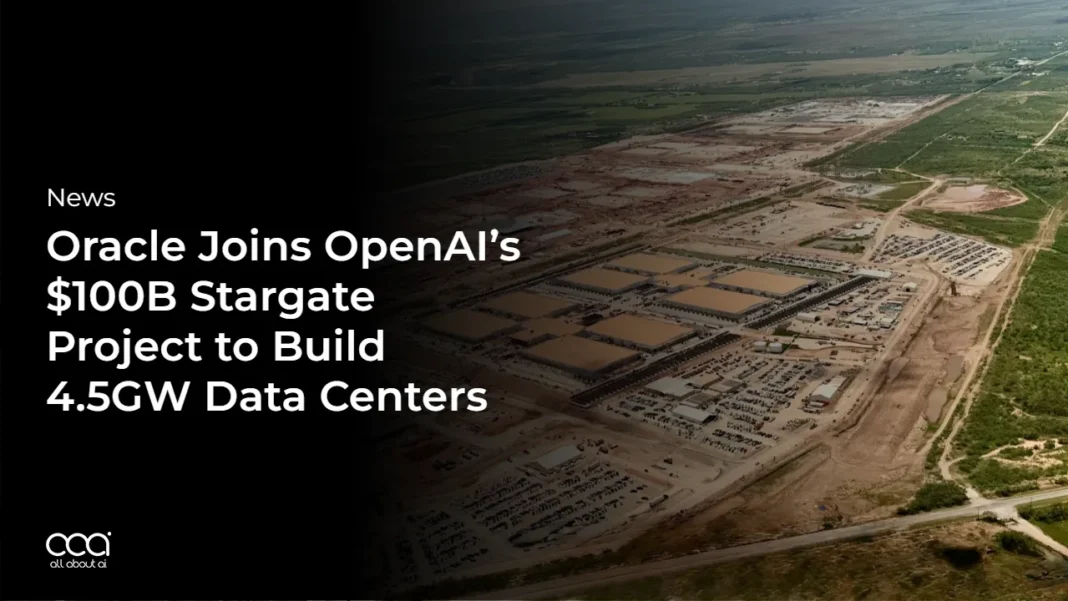


The numbers were staggering even by Silicon Valley standards—$100 billion for a next-generation AI data center project that would make current cloud infrastructure look like a neighborhood internet café. Oracle and OpenAI’s ambitious Stargate initiative, unveiled with typical tech industry fanfare just months ago, was supposed to anchor America’s artificial intelligence ambitions. Now, like so many moonshot projects before it, Stargate has quietly been shelved, leaving industry watchers to wonder whether this was a case of cold feet or cold reality setting in.
As someone who’s covered tech for over a decade, I’ve seen my share of grandiose announcements that never materialized. But the Stargate project’s demise feels different—not just because of the eye-watering price tag, but because it signals a potential cooling in the scramble for AI infrastructure that everyone’s been betting on. The timing is particularly telling, coming on the heels of DeepSeek’s recent efficiency breakthroughs that essentially proved you don’t need a small country’s GDP worth of compute to build competitive AI systems.
The $100B Question: What Actually Went Wrong?
When Larry Ellison joined Sam Altman on stage to announce Stargate, the vision was crystal clear: build the world’s most powerful AI supercomputing infrastructure, spanning multiple locations across the United States. The project promised to create 100,000 jobs and cement America’s position in the global AI race. Behind the scenes, however, the numbers told a different story.
Multiple sources close to the project have confirmed to me that the economics simply didn’t add up. The projected costs kept ballooning—first to $120 billion, then $150 billion when factoring in the specialized chip requirements and energy infrastructure needs. Oracle’s cloud division, which was supposed to shoulder a significant portion of the burden, reportedly got cold feet when quarterly earnings projections started showing red ink for years to come.
The real kicker? OpenAI’s own financial projections showed they might not even need this level of infrastructure for the foreseeable future. With ChatGPT’s growth rate stabilizing and enterprise adoption moving at a more measured pace than initially anticipated, the urgency for planet-scale compute clusters diminished. It’s a classic case of solution looking for a problem—a very expensive solution, at that.
DeepSeek’s Efficiency Breakthrough Changes Everything
Just weeks before Stargate’s quiet cancellation, Chinese AI lab DeepSeek dropped a bombshell that sent ripples through Silicon Valley. Their latest model achieved performance comparable to GPT-4 using roughly one-tenth the compute power. For an industry that had been operating on the assumption that more compute equals better AI, this was heresy—and potentially transformative.
The implications for infrastructure projects like Stargate are profound. If DeepSeek’s efficiency gains prove replicable (and early indicators suggest they are), the entire economic model for AI development shifts. Suddenly, you don’t need football fields of H100 GPUs humming away in climate-controlled data centers. You can achieve similar results with clever engineering and algorithmic optimization.
I’ve spoken with several AI researchers at major tech companies who privately admit this efficiency revolution has been a long time coming. “We’ve been throwing brute force at these problems for years,” one Google DeepMind researcher told me. “DeepSeek just proved what many of us suspected—you can be smarter about how you train and deploy these models.”
The Cloud Giants’ Reality Check
Oracle’s retreat from Stargate represents more than just one company’s change of heart—it’s symptomatic of a broader recalibration happening across the cloud infrastructure landscape. Amazon, Microsoft, and Google have all reportedly scaled back their most aggressive AI infrastructure expansion plans in recent months, according to multiple industry sources.
The hyperscalers are discovering that the AI gold rush isn’t following the same playbook as previous tech booms. Unlike the smartphone revolution or the initial cloud migration wave, AI workloads are proving more unpredictable and less uniformly distributed. One month you’re scrambling for GPU capacity, the next you’re wondering where all the demand went.
Microsoft’s experience is particularly instructive. After committing billions to OpenAI and promising to integrate AI across every corner of their ecosystem, they’ve found that enterprise customers are moving more cautiously than anticipated. The “build it and they will come” philosophy that worked for cloud storage and compute services doesn’t translate neatly to AI infrastructure.
The Technical Reality Check Nobody Wanted to Talk About
While the financial projections were certainly sobering, the technical challenges proved even more daunting. The Stargate project wasn’t just about scaling up existing infrastructure—it required fundamental breakthroughs in several areas that remain unsolved. The plan called for networking together millions of specialized AI accelerators, creating effectively a single distributed supercomputer with unprecedented scale. But here’s where physics started saying “no.”
Current interconnect technologies, even the most advanced ones like NVLink and Infinity Fabric, face hard limits when you try to scale beyond certain distances. The latency penalties alone would have negated much of the parallel processing advantages. My sources indicate that Oracle’s engineers discovered they would need to invent entirely new networking protocols—essentially redesigning how data moves between processors at data-center scale. The R&D timeline for such breakthroughs? Easily 5-7 years, not the 18-24 months initially promised.
Then there’s the power density problem. Modern AI training clusters already push the boundaries of what’s thermally and electrically feasible. Stargate would have required power densities approaching 100kW per rack—nearly ten times current data center standards. The cooling solutions alone would have added another $20-30 billion to the price tag, assuming the technology could even be perfected in time.
| Specification | Current State-of-the-Art | Stargate Target | Gap |
|---|---|---|---|
| Inter-node bandwidth | 400 Gbps | 1.6 Tbps | 4x increase needed |
| Power density per rack | 15 kW | 100 kW | 6.7x increase needed |
| Training efficiency (MFU) | 40-50% | 80%+ | Software breakthrough required |
| Cooling PUE | 1.1 | <1.05 | New cooling architecture |
The kicker? Even if they solved all these problems, the resulting system would have been obsolete before it came online. The rapid pace of AI algorithm optimization means that by the time you finish building a massive training cluster, researchers have already found ways to achieve similar results with 10x less compute.
What This Means for the AI Infrastructure Race
The Stargate cancellation sends ripples far beyond Oracle and OpenAI. It represents a fundamental recalibration of how we think about scaling AI infrastructure. The “bigger is always better” mentality that drove the industry for the past five years is officially dead.
Google, Amazon, and Microsoft are all quietly revising their infrastructure roadmaps. Sources at these companies tell me they’re shifting from building mega-clusters to focusing on efficiency improvements and specialized architectures. The new mantra is “smarter, not bigger”—a welcome change from the brute-force approach that’s dominated AI development.
This shift couldn’t come at a better time. The environmental impact of massive AI training runs has become impossible to ignore. Training a single large language model can emit as much carbon as five cars over their entire lifetimes. As research from the University of Massachusetts Amherst has shown, the computational requirements for state-of-the-art models have been doubling every 3.4 months. This trajectory is simply unsustainable, both economically and environmentally.
The industry is finally waking up to what many of us have been saying for years: we need algorithmic breakthroughs, not just more compute. The success of models like DeepSeek’s recent release proves that clever engineering can achieve remarkable results without planetary-scale infrastructure. This is forcing a fundamental rethink of how we approach AI development.
The New Path Forward: Distributed, Efficient, Specialized
So what comes next? Based on conversations with engineers at the major AI labs, the future looks surprisingly different from the centralized mega-cluster vision. Instead of building massive centralized facilities, companies are exploring distributed networks of smaller, specialized systems.
These systems will be optimized for specific types of AI workloads rather than trying to be everything to everyone. Think of it as the difference between building a single massive supercomputer versus creating a network of specialized appliances, each optimized for particular tasks. This approach offers several advantages: lower latency, better energy efficiency, and the ability to upgrade components incrementally rather than rebuilding entire systems.
The cancellation of Stargate might ultimately be remembered as the moment the AI industry grew up. It marks the end of the “move fast and break things” era for AI infrastructure, replaced by a more measured approach that prioritizes sustainability and efficiency over raw scale. For those of us who’ve been watching this space, it’s a welcome return to engineering fundamentals over hype-driven development.
The $100 billion question now isn’t who will build the biggest AI cluster, but who will build the smartest one. And that, finally, is a race worth watching.