
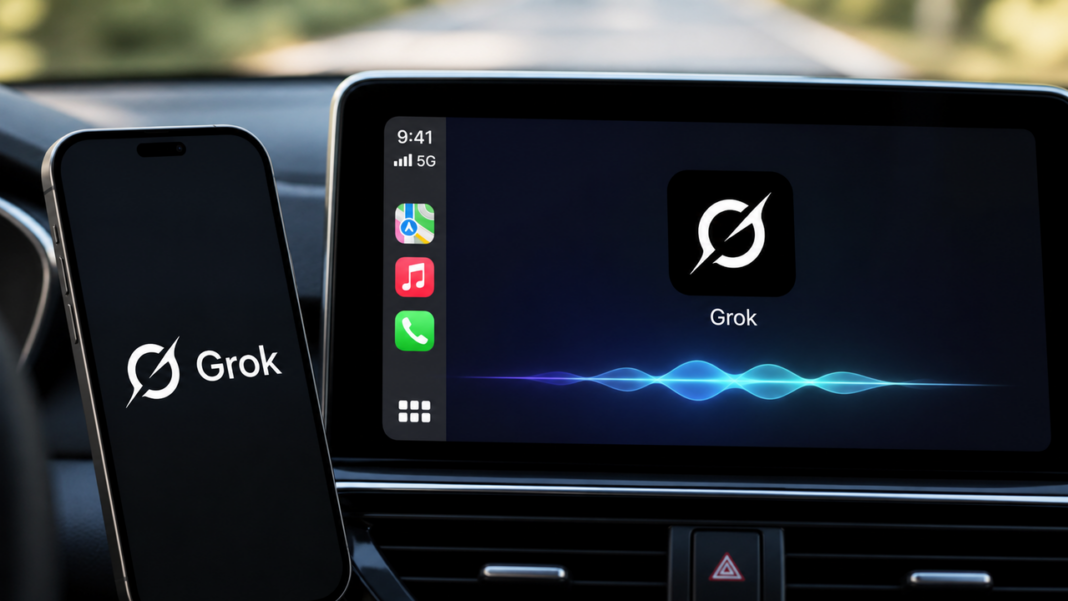


There is a specific kind of magic—or perhaps, a quiet, modern chaos—to the morning commute. We’ve all been there: coffee in the cup holder, the sun just beginning to peek over the horizon, and the dashboard glowing with the promise of connectivity. For years, we’ve relied on the familiar, polite chime of Siri to navigate us through the gridlock. But lately, the digital passenger seat has started to feel a bit crowded. A fresh discovery hidden within the latest update to the Grok for iPhone app suggests that xAI is ready to pull up to the curb, signaling that Elon Musk’s AI powerhouse is preparing to take a permanent seat in our vehicles via Apple CarPlay.
The Road Beyond the Tesla Ecosystem
For those who have been tracking the rapid evolution of xAI, the move to CarPlay feels like the next logical step in a high-stakes game of automotive chess. Until now, the Grok experience has been largely siloed within the sleek, minimalist confines of Tesla vehicles. It was an exclusive club, a digital companion built into the very architecture of the car. By pivoting toward the broader Apple CarPlay ecosystem, xAI is effectively tearing down the velvet rope. This isn’t just a software update; it’s a strategic expansion that aims to put a conversational, often sharp-witted AI into the hands—or rather, the dashboards—of millions of drivers across virtually every major automotive brand.
The evidence, for now, is a quiet placeholder. Users digging into the latest version of the Grok iOS app have been met with a simple, tantalizing message: “Grok Voice mode coming soon to CarPlay.” It is a classic tech-world breadcrumb, the kind that hints at a seismic shift in how we interact with our cars. While the feature remains non-functional at this exact moment, the intent is unmistakable. xAI is looking to transform the dashboard from a simple navigation and music hub into a sophisticated, hands-free productivity engine that understands the nuances of human speech far better than the static voice assistants of yesteryear.
A Crowded Dashboard: The Battle for Your Commute
If you think the digital dashboard is already packed, you’re right. The arrival of Grok into the CarPlay ecosystem isn’t happening in a vacuum; it’s an entry into a fiercely contested arena. Currently, the landscape is already occupied by heavy hitters like ChatGPT and Perplexity, both of which have staked their claims as the go-to AI for drivers seeking quick answers, itinerary planning, or just a bit of conversational company during a long haul. By entering this space, xAI is signaling that they aren’t content to let OpenAI or Perplexity define the standard for in-car artificial intelligence.
What makes this particularly fascinating is the shift in how we view “driver safety” versus “driver convenience.” The promise here is a truly hands-free interaction model. We aren’t just talking about asking for directions or skipping a track; we’re talking about managing complex productivity tasks, firing off queries, and navigating through our digital lives without ever needing to glance at a screen. While Google has taken a different route—opting to let its Gemini model influence the future of Apple’s own Siri rather than launching a standalone CarPlay app—xAI is choosing the direct approach. They want Grok to be a distinct, recognizable presence in your car, a personality that you actively choose to engage with every time you turn the ignition. For more on this topic, see: NASA’s Latest Space Mission Just . For more on this topic, see: Breaking: Trump Crypto Firm Confirms .
It’s a bold play, and one that highlights the growing consumer demand for AI that actually feels like a partner rather than a tool. We’ve spent enough time shouting at voice assistants that don’t understand us; the race is now on to see who can provide the most natural, helpful, and intuitive experience while we’re busy navigating the real world. As we wait for that “coming soon” placeholder to transform into a live, interactive interface, the question remains: how much personality do we actually want in our dashboard?
The Architecture of the Modern Dashboard
To understand why this shift matters, we have to look at the dashboard not as a piece of hardware, but as a battleground for our attention. For years, the automotive interface was a stagnant space—a collection of static menus and clunky GPS systems. Then came the era of smartphone projection, led by Apple CarPlay, which finally allowed our digital lives to seamlessly sync with our vehicles. Now, we are entering the third act: the era of the conversational agent.
Grok is entering a crowded room. As it prepares to join the CarPlay ecosystem, it finds itself standing alongside established players like ChatGPT and Perplexity. This isn’t just about adding another icon to your screen; it’s about the underlying philosophy of how we want our cars to “think.” While traditional assistants are designed for transactional requests—”Play this song,” or “Navigate to the nearest gas station”—the new wave of AI is built for dialogue. They are designed to follow the thread of a conversation, allowing for a more human-like exchange that doesn’t break the flow of the drive.
| Feature | Traditional Assistants | Conversational AI (Grok/ChatGPT) |
|---|---|---|
| Interaction Style | Command-based | Context-aware dialogue |
| Flexibility | Rigid syntax required | Natural language processing |
| Complexity | Simple tasks only | Multi-step reasoning |
The Human Element: Why Tone Matters
There is a distinct personality difference that sets xAI’s offering apart. If Siri is the polite, slightly reserved administrative assistant, and ChatGPT is the helpful, encyclopedic librarian, Grok—by design—is intended to be the witty, unfiltered conversationalist. For the daily commuter, this shift in tone is significant. Driving is often a solitary, meditative, or sometimes frustrating experience. Having an AI that can handle complex queries with a bit of “edge” or humor can fundamentally change the atmosphere inside the cabin.
However, this brings up a fascinating question about the intersection of AI safety and personality. As these systems move into our vehicles, the developers must navigate the balance between a “fun” persona and the high-stakes requirement of keeping a driver focused on the road. The challenge for xAI won’t just be technical integration; it will be ensuring that the “Grok experience” remains engaging without becoming a distraction. It’s a delicate dance between innovation and responsibility.
Looking Ahead: The Connected Horizon
As we wait for the official rollout, it is worth considering what this means for the broader automotive industry. The move to CarPlay suggests that xAI recognizes a fundamental truth: you cannot force users to switch cars to access your software. By meeting users on the platform they already use, xAI is positioning itself to be a ubiquitous layer of intelligence across the global fleet. This is a departure from the “walled garden” approach of early EV software, signaling a more open, competitive future for in-car technology.
For more information on the standards and guidelines governing these technologies, you can explore the following resources:
Ultimately, the arrival of Grok on CarPlay is a reminder that our vehicles are becoming extensions of our personal digital spheres. Whether you find the idea of an AI passenger thrilling or slightly daunting, one thing is certain: the days of the “dumb” dashboard are numbered. We are moving toward a future where our cars don’t just take us from point A to point B; they talk us through the journey, offering insights, managing our schedules, and perhaps even sharing a laugh along the way. As I pull out of my driveway tomorrow, I’ll be watching my screen closely, waiting for that little icon to appear—a small, digital sign that the future of the road is about to get a lot more interesting. For more on this topic, see: Breaking: A24’s Award Winners Hit .