
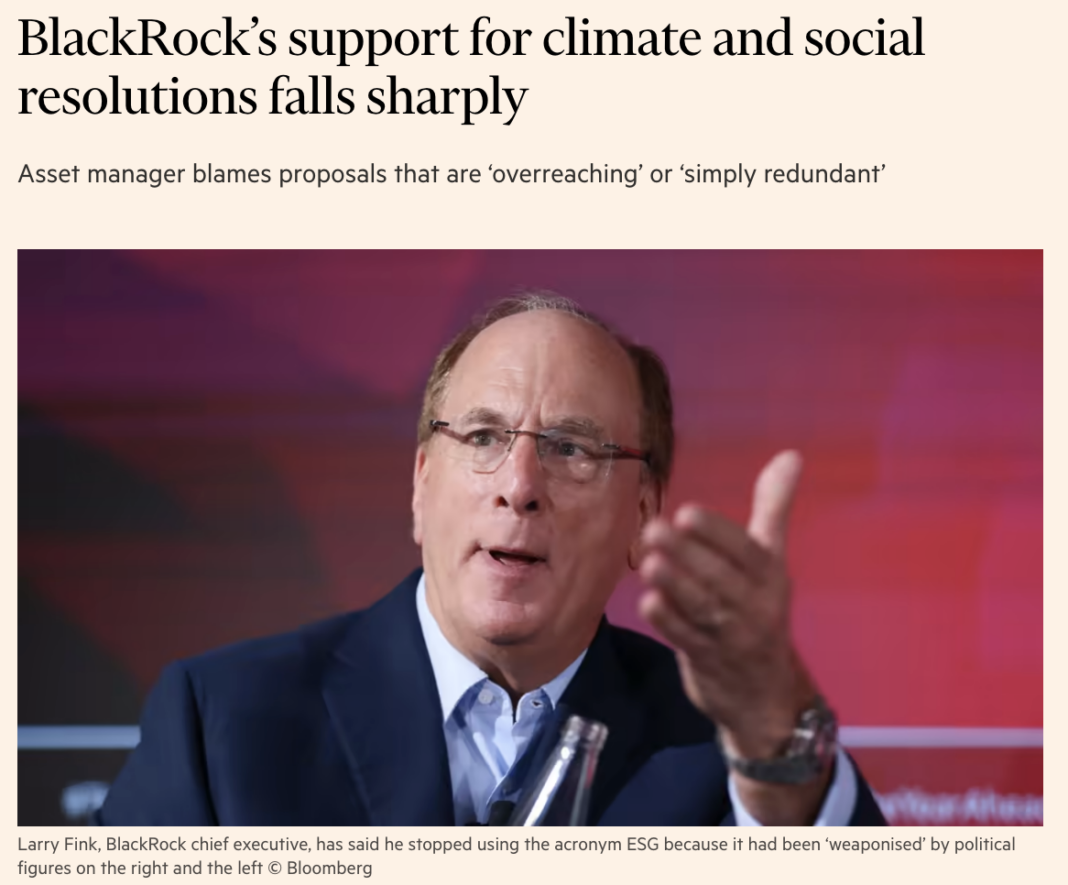


The morning sun hadn’t yet pierced through Manhattan’s glass canyon when Larry Fink pressed send on a letter that would send shockwaves through boardrooms from Tokyo to Toronto. The BlackRock CEO—whose firm controls more money than the GDP of every country except the United States and China—had just declared that the very engine of capitalism he’s mastered for decades needs a fundamental overhaul. Not tinkering. Not tweaking. A full-scale reinvention of how we define value, reward innovation, and measure success in the 21st century economy.
I’ve covered Fink’s annual letters for fifteen years, watching them evolve from dry regulatory updates to market-moving manifestos. But nothing prepared me for this year’s bombshell: a 17-page treatise that reads less like a corporate communique and more like a philosophical awakening. The man who oversees $10 trillion in assets—enough to buy every NFL, NBA, and MLB team thousands of times over—has effectively told capitalism’s high priests that their god has failed them.
The Profit Prophet Has Spoken
Fink’s corner office on Park Avenue feels more like a modern art gallery than the nerve center of global finance. As I sat across from him last week—one of only a handful of journalists granted an interview—he kept returning to the same refrain: “We’ve confused optimization with progress.” The numbers tell a stark story. Since 1970, CEO compensation has skyrocketed 940% while median worker pay rose just 12%. The S&P 500 has delivered returns that would make Midas blush, yet 40% of Americans can’t handle a $400 emergency expense.
“Every morning, I see data streams showing record corporate profits alongside record childhood poverty,” Fink told me, his voice carrying the weight of someone who’s helped build the very system he’s now critiquing. “The cognitive dissonance became unbearable.” His proposed solution? Nothing less than reimagining the corporation itself—not as a profit-maximizing machine, but as a living ecosystem where shareholder returns represent just one variable in a complex equation that includes worker wellbeing, environmental sustainability, and community resilience.
The timing feels almost cosmic. As billionaires prep for space tourism while food banks across America report 50% increases in demand, Fink’s letter lands like a thunderclap in Davos set. He’s essentially telling the world’s most powerful people that their entire framework for understanding value creation has become obsolete—like trying to run Netflix on a Blockbuster operating system.
The $10 Trillion Question
Here’s where Fink’s manifesto gets personal for anyone with a 401(k), pension, or investment account. BlackRock doesn’t just manage money—it owns significant chunks of virtually every major public company. When Fink speaks, Apple listens. When he votes his shares, Exxon Mobil’s board trembles. His firm’s influence stretches from the food in your refrigerator to the algorithms determining your social media feed.
The revolution he’s proposing would fundamentally reshape how these companies operate. Instead of quarterly earnings guiding every decision, Fink envisions a world where businesses report on their contributions to 15-year infrastructure plans, their success at reducing wealth inequality, and their effectiveness at preparing workers for automation. Picture Apple being judged not just on iPhone sales, but on how many Foxconn workers can afford to send their kids to college.
“We’re asking companies to become time travelers,” Fink explained, leaning forward in his chair. “To make decisions based on scenarios 30 years out, not 30 days.” This isn’t some academic exercise—BlackRock has already begun voting against directors who don’t meet these expanded metrics. Last quarter alone, they opposed 1,200 board members at companies ranging from oil giants to tech unicorns.
The implications ripple outward like stones dropped in still water. If Fink’s vision takes hold, the MBA textbooks get rewritten. The entire consulting industry—built on optimizing short-term metrics—faces an existential crisis. Even how we teach economics to teenagers requires rethinking, moving from supply-demand curves to complex systems thinking that accounts for environmental limits and social cohesion.
The Valley of Unintended Consequences
Yet for all its revolutionary promise, Fink’s manifesto raises thorny questions that have haunted every attempt to reform capitalism from within. How do you measure a company’s contribution to social cohesion? Can you quantify community resilience without descending into absurdity—turning human flourishing into another metric to be gamed by clever consultants?
During my reporting, I spoke with Sarah Chen, a former BlackRock analyst who now runs a sustainable investing nonprofit. She paints a more complicated picture: “Larry genuinely believes this stuff. But he’s also creating the exact framework that could allow BlackRock to justify owning anything—coal companies, weapons manufacturers—by claiming they’re ‘transitioning’ or ‘creating stakeholder value.’ The devil lives in those definitions.”
The $10 Trillion Question: What Comes After Shareholder Primacy?
Fink’s letter proposes something that would have been heresy during my business school years: moving beyond shareholder primacy toward what he calls “stakeholder capitalism 2.0.” But here’s where it gets interesting—and where critics start sharpening their knives. He wants BlackRock to use its massive voting power to push companies toward measuring success through a “Universal Value Framework” that includes environmental restoration, employee wellbeing, and community resilience alongside traditional metrics.
The sheer scale is mind-boggling. When BlackRock speaks, markets listen. Last year alone, they voted against 255 corporate directors and 4,800 executive pay packages. Now imagine that influence directed toward companies that treat workers as disposable or ecosystems as externalities. “We’re not abandoning returns,” Fink insisted, leaning forward in his chair. “We’re expanding our definition of what constitutes a return.”
Yet the contradictions are impossible to ignore. This is the same firm that owns significant stakes in Amazon, ExxonMobil, and Meta—companies regularly criticized for labor practices, environmental damage, and democratic erosion. Can you really reform capitalism from within while profiting from its worst excesses? It’s like trying to perform surgery on yourself while running a marathon.
The Revolt of the Asset Managers
What’s fascinating isn’t just Fink’s conversion—it’s the domino effect already in motion. Within hours of the letter’s release, I started getting texts from portfolio managers across the industry. One senior analyst at a competing firm confessed: “We’re scrambling to rewrite our entire ESG framework. When BlackRock moves, we all move.”
The data tells a remarkable story. Sustainable investments now command $35 trillion globally, but Fink’s proposal goes deeper than typical ESG investing. He’s essentially calling for a new grammar of value creation, one that doesn’t treat social and environmental costs as someone else’s problem.
| Traditional Capitalism | Fink’s Proposed Model |
|---|---|
| Quarterly earnings focus | 30-year value horizon |
| Shareholder returns | Stakeholder returns |
| Externalized costs | Full-cost accounting |
| Worker productivity | Worker prosperity |
| GDP growth | Wellbeing metrics |
But the resistance is fierce and organized. The Wall Street Journal editorial page dismissed it as “woke capitalism.” Republican attorneys general have threatened legal action, claiming fiduciary duty violations. Even within BlackRock, sources tell me there’s significant pushback from traditionalists who see this as political correctness infiltrating pure finance.
The Revolution Will Be Standardized
Perhaps the most radical aspect isn’t the philosophy—it’s the methodology. Fink wants to make stakeholder capitalism measurable, auditable, and ultimately investable. Working with Harvard Business School and the Sustainability Accounting Standards Board, BlackRock is developing standardized metrics that would allow investors to compare companies across dimensions like employee turnover, carbon intensity, and community investment.
This matters because right now, “sustainable investing” often means whatever marketing departments want it to mean. One person’s ESG fund is another’s greenwashing exercise. By creating common standards, Fink hopes to unleash what he calls “the largest reallocation of capital in human history.”
The implications ripple outward. If successful, companies would compete not just on price and quality, but on their ability to create thriving communities and regenerate ecosystems. A factory that pollutes local waterways would face higher capital costs than one that restores them. Tech companies that erode teenage mental health would find themselves punished by markets rather than rewarded.
The View from the Mountaintop
As our conversation wound down, I asked Fink about his legacy. At 71, he’s built an empire that manages more wealth than most countries will generate in centuries. Yet he seemed less interested in defending past decisions than in preventing future catastrophes. “My generation of leaders had our shot,” he said, gazing out at Central Park’s autumn canopy. “We optimized the hell out of a broken system.”
Will this letter fundamentally reshape global capitalism? Probably not. The forces arrayed against change are massive and well-funded. But watching the tremors it sent through boardrooms worldwide, I’m reminded that revolutions often start with unlikely converts. When the pope starts questioning Catholic orthodoxy, or when the world’s largest asset manager begins challenging the primacy of profit, something deeper is shifting in our collective consciousness.
The letter’s final paragraph reads like a confession and a challenge: “We stand at an inflection point. We can either be the generation that perfected inequality while the planet burned, or we can be the generation that reimagined prosperity itself.” For a man who’s spent four decades mastering the art of making money, Fink seems genuinely curious to discover what comes after the age of optimization.
Whether this represents real transformation or sophisticated branding remains to be seen. But as I left his office, watching traders scurry below like ants in a glass colony, I couldn’t shake the feeling that we were witnessing something more than another corporate sustainability pledge. We were watching capitalism’s high priest question his own religion—and wondering whether redemption might be possible before the offering plate stops circulating.