
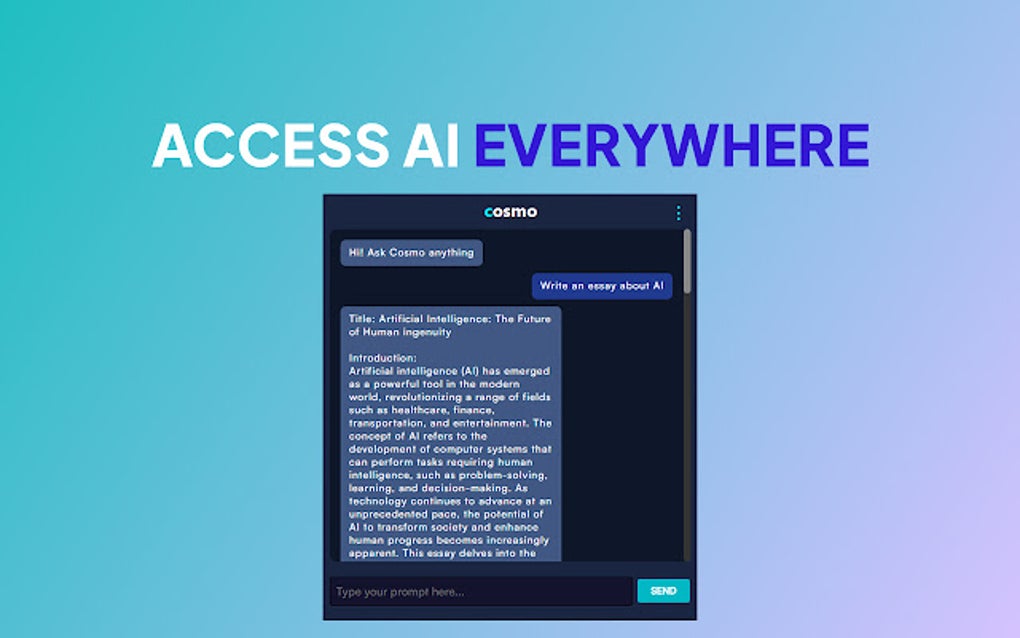


There is a specific kind of digital ghost story that haunts the halls of Silicon Valley: the accidental upload. It’s the late-night slip of a finger, a misconfigured server, or a developer’s weary “publish” click that sends a secret project tumbling into the public eye. Last week, for a fleeting five-hour window, that ghost took the form of COSMO. For a brief moment, the Google Play Store hosted a mysterious, experimental AI assistant that wasn’t supposed to be there, and just as quickly as it arrived, it vanished back into the ether. But in that short, frantic lifespan, COSMO offered us a rare, unvarnished glimpse into the next frontier of our digital lives: the era of the truly local, on-device AI.
The Ghost in the Machine: What Was COSMO?
When users first stumbled upon the listing under the package name com.google.research.air.cosmo, it didn’t look like a polished consumer product. It was raw, experimental, and undeniably ambitious. Published under Google’s main developer account, the app was a window into the labs of Google Research, designed not as a cloud-dependent chatbot, but as a proactive companion that lives and breathes within the silicon of your own phone. Unlike the AI we interact with today—which usually sends your data on a round-trip journey to a distant server farm—COSMO was built to leverage Gemini Nano, Google’s most efficient on-device model.
The sheer footprint of the app was the first tell that this wasn’t just a simple interface wrapper. Clocking in at over 1GB, COSMO demanded a significant chunk of storage, a clear signal that it wasn’t just fetching answers; it was carrying the weight of its own intelligence locally. While the interface was reportedly a bare-bones, no-frills chat window, the intent behind it was massive. This was a tool designed to operate in the background, a silent partner capable of weaving through your daily habits without ever needing to ping the cloud for permission.
Permission to Automate: The Power and the Peril
What makes COSMO particularly fascinating—and perhaps a little terrifying—is the level of access it required to function. To truly act as an assistant, the app leaned on Android’s AccessibilityService API. For those who aren’t knee-deep in mobile development, this is essentially the “keys to the kingdom” permission. It allows an app to read the content of your screen, track your interactions, and even automate browser behavior. It is a powerful, double-edged sword; historically, this permission has been the primary hunting ground for malware, yet in the hands of a legitimate, privacy-focused AI, it is the bridge between a static chatbot and a proactive agent.
By utilizing this API, COSMO was positioned to be more than just a search engine. It was built to be a digital concierge: a tool that could summarize your conversations, draft documents in real-time, suggest events based on your actual screen activity, and conduct “Deep Research” without you having to copy-paste your way through a dozen tabs. It represents a fundamental shift in how we think about AI. We are moving away from the “ask-and-receive” model and toward a future where our devices are constantly watching, learning, and anticipating our needs. It’s a compelling, deeply human-centric vision of technology, though one that forces us to reckon with just how much autonomy we are willing to grant the software in our pockets. For more on this topic, see: What Google’s Sneaky Icon Size .
The experimental suite included a List Tracker and a Document Writer, features that suggest Google is experimenting with an AI that doesn’t just talk at you, but works alongside you. It is the difference between a library assistant who points you to a book and a personal secretary who writes the report for you. But as we peel back the layers of this accidental release, the questions begin to mount. If an AI is running locally, processing our most sensitive screen data, and automating our web browsing, what happens when it makes a mistake? And more importantly, how does Google plan to keep this level of power both accessible and safe for the average user? For more on this topic, see: What Fallout’s Mysterious Countdown Reveals .
The Permission Paradox: Balancing Capability and Caution
The most revealing—and perhaps most startling—element of COSMO wasn’t just what it could do, but how it proposed to do it. To function as a truly proactive assistant, the app requested access to the Android AccessibilityService API. For the uninitiated, this is a “god-mode” permission. It allows an application to “see” what is on your screen, interact with other apps, and even automate browser navigation. While this is necessary for an AI to act as a genuine agent—helping you book a flight or summarize a complex web page—it is also the same permission set that security researchers have spent years teaching users to fear, as it has historically been a vector for malicious software.
This creates a fascinating Permission Paradox. If we want our AI to be a helpful, autonomous partner, we must grant it the keys to the kingdom. We are essentially choosing between a “dumb” AI that sits behind a wall, safe but isolated, and a “smart” AI that requires a degree of digital intimacy that feels inherently risky. Google’s experiment with COSMO suggests that the future of mobile computing is moving toward this deeper, more invasive level of integration. To understand the technical framework that makes this possible, it is worth looking at the evolution of mobile architecture and the standards Google is setting for local processing.
| Feature | Cloud-Based AI | On-Device AI (e.g., COSMO) |
|---|---|---|
| Privacy | Data leaves the device | Data stays local |
| Latency | Dependent on network speed | Near-instantaneous |
| Autonomy | Limited by API calls | Deep system integration |
| Resource Drain | Low device battery impact | High CPU/RAM utilization |
The Shift Toward “Deep Research” and Local Autonomy
What truly set COSMO apart from the current crop of voice-activated assistants was its inclusion of a “Deep Research” mode. Most of us are accustomed to AI that acts as a search engine surrogate—we ask a question, it fetches a snippet. COSMO, however, appeared designed to synthesize information over time, acting more like a digital researcher than a mere query-responder. By keeping this process on-device, Google is solving the problem of context. When an AI lives on your phone, it knows your calendar, your drafted documents, and your browsing habits without needing to upload your entire life to a server. For more on this topic, see: What Nintendo’s New President’s First .
This shift represents a fundamental change in how we view our hardware. We are moving away from phones as “communication devices” and toward phones as “cognitive extensions.” The 1GB footprint of COSMO is a small price to pay for a system that can theoretically write a document, organize a schedule, and summarize a week’s worth of emails without ever pinging a cloud database. It is a bold vision of privacy-first computing, even if the implementation—as evidenced by the accidental release—is still very much in its infancy.
For those interested in the technical standards and research initiatives driving these developments, you can explore the official documentation and research papers provided by the following institutions:
The Horizon of Personal Intelligence
The fleeting appearance of COSMO was a reminder that we are currently living in the “wild west” of the AI era. We are watching the transition from AI as a novelty feature to AI as a foundational layer of the operating system. While Google will surely polish the rough edges, restrict the permissions, and refine the interface before we see this technology again, the genie is already out of the bottle.
The real story here isn’t the accidental upload; it’s the inevitable arrival of a digital companion that knows you better than any cloud service ever could. As we move toward this future, we have to ask ourselves: are we ready to grant our devices this level of access? The convenience will be transformative, but the responsibility of managing that “ghost in the machine” will fall squarely on us. When the next version of COSMO arrives—and it will—it won’t be an accident. It will be the new standard of how we interact with the world, turning our phones from passive tools into active, intelligent participants in our daily lives.