
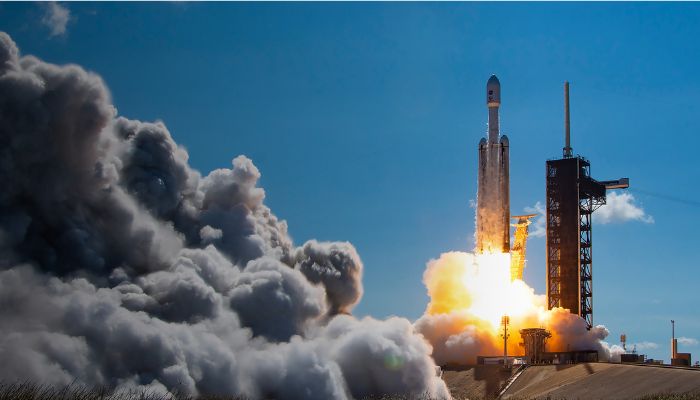


If you thought the space race was just a relic of the 1960s, you clearly haven’t been checking the skies over the Space Coast lately. While the rest of us are busy scrolling through TikTok trends or debating the latest streaming service drop, Elon Musk’s SpaceX has been busy rewriting the laws of orbital logistics. They’ve officially hit a staggering 101 launches for the year, a milestone that feels less like an aerospace achievement and more like a flex on the entire history of human flight. It’s the kind of high-octane, high-stakes efficiency that makes even the most jaded entertainment reporter stop and look up—because let’s face it, when you’re launching rockets with the frequency of a cable network releasing new episodes, you’ve officially transitioned from “experimental tech” to “essential infrastructure.”
The New Normal: Scaling at Warp Speed
Let’s talk numbers, because the trajectory here is frankly dizzying. We aren’t just looking at a steady climb; we’re looking at a vertical ascent. In 2023, SpaceX managed 68 launches, which at the time felt like a massive feat. By 2024, that number bumped up to 88. Now, hitting 101 launches in 2025? That’s not just growth; that’s a masterclass in industrial scaling. It’s clear that the demand for orbital access is skyrocketing, and SpaceX is the only player in the game capable of keeping up with the hunger for satellite deployment and commercial cargo.
There’s a certain “pop culture” element to this operational speed. Much like the way we’ve become accustomed to binge-watching entire seasons in a single weekend, the industry has become accustomed to SpaceX’s relentless cadence. They’ve turned a once-in-a-lifetime event into a daily occurrence, effectively normalizing the extraordinary. Whether it’s for NASA or private enterprise, the reliability of this launch cycle has shifted the conversation from “will it make it to orbit?” to “what’s next on the manifest?” It’s a bold, confident pace that leaves competitors scrambling to find their footing in a market that SpaceX currently owns, lock, stock, and barrel.
The Unstoppable Workhorse: The Falcon 9 Legacy
Behind every major blockbuster is a star performer, and in the SpaceX universe, that star is undoubtedly the Falcon 9. It’s the reliable, gritty, and incredibly consistent workhorse that has shouldered the burden of all 101 launches this year. While we love to talk about the shiny, experimental prototypes and the futuristic ambitions of Starship, the Falcon 9 is the vehicle that actually does the heavy lifting. It’s the equivalent of the long-running procedural drama that keeps the studio lights on—unflashy, perhaps, but absolutely vital to the bottom line.
The reliance on this specific hardware is total. Even as we head into the next phase of the year, with 26 launches already recorded for 2026 as of May 1, the Falcon 9 continues to dominate the manifest. It’s a testament to the design’s durability and the team’s ability to turn these rockets around with record-breaking speed. When you see a rocket streak across the Florida sky, you’re looking at the same architecture that has become the backbone of modern spaceflight. It’s a rare moment in tech where a design doesn’t just work—it becomes the standard by which all other efforts are measured, effectively creating a monopoly on reliability.
Beyond the Cargo: Human Spaceflight as the New Frontier
Of course, it’s not just about satellites and cargo; it’s about the people. SpaceX has cemented itself as the primary taxi service for the stars, managing a roster of human spaceflight missions that reads like a high-profile guest list. From the Crew-10 and Crew-11 missions to the Ax-4 flights, the company is juggling NASA’s rigorous safety requirements alongside the growing appetite for commercial space travel. It’s a delicate balancing act that they seem to be performing with an unnerving amount of ease. For more on this topic, see: What George R. R. Martin’s .
This is where the narrative shifts from mere “launch statistics” to the human drama of exploration. By supporting these missions with such regularity, SpaceX is effectively democratizing access to low Earth orbit. We’re moving toward a future where “going to space” is becoming less of a legendary, once-in-a-generation achievement and more of a professional assignment. It’s an exciting, albeit slightly surreal, shift in our cultural landscape. As we look at the manifest for the coming months, it’s clear that the rhythm of these missions is only going to intensify as more participants join the orbit-bound crowd.
The Workhorse Effect: Why Falcon 9 is the Real MVP
When we talk about the “SpaceX effect,” we’re really talking about the Falcon 9. It’s the ultimate workhorse of the modern era, the reliable lead actor that shows up on set every single day, ready to deliver a flawless performance. While Starship grabs the headlines with its sheer size and “cool factor,” the Falcon 9 is the backbone of this 101-launch milestone. It’s the platform that has turned space travel from a high-budget blockbuster production into a reliable, recurring series. For more on this topic, see: NASA’s Latest Space Mission Just .
The efficiency isn’t just about the hardware; it’s about the turnaround. By perfecting the art of reusability, SpaceX has essentially introduced “re-runs” to the aerospace industry, but in the best way possible. They aren’t building a new rocket from scratch for every mission; they are refurbishing, inspecting, and sending the same boosters back up with a speed that makes the traditional aerospace giants look like they’re stuck in the era of silent films. This level of operational maturity is why they can handle everything from high-stakes NASA human spaceflight missions to commercial satellite deployments without breaking a sweat. For more on this topic, see: What Nintendo’s New President’s First .
| Year | Total SpaceX Launches | Key Focus |
|---|---|---|
| 2023 | 68 | Rapid Scaling |
| 2024 | 88 | Fleet Maturity |
| 2025 | 101 | Operational Dominance |
From Sci-Fi to Reality: The Human Element
Perhaps the most compelling part of this story isn’t the metal or the fuel—it’s the human element. We’ve moved past the phase where spaceflight was exclusively for government-trained astronauts with decades of experience. With missions like Crew-10, Ax-4, and Crew-11, SpaceX is acting as the primary transit provider for a new era of orbital activity. They are the gatekeepers to the stars, and for the first time in history, the gate is wide open.
This shift feels like the democratization of the final frontier. When you look at the manifest for 2025, it’s a mix of research, commercial infrastructure, and human exploration. It’s no longer about just “getting there”; it’s about what we do once we arrive. For those of us watching from the ground, it’s a fascinating pivot. We’re seeing a future where orbital transit is as mundane as a cross-country flight, and that’s a massive cultural shift. It changes our perspective on how small the world is and how accessible the cosmos has become.
The Future Manifest: What’s Next?
If 101 launches is the baseline, where does the ceiling sit? Looking ahead into early 2026, the tempo hasn’t slowed down. With nearly 30 launches recorded in the first few months of the new year, it’s clear that the “SpaceX pace” isn’t a temporary spike—it’s the new industry standard. The question for the rest of the world isn’t “can they keep this up?” but rather “how will the rest of the world adapt to a reality where space is always ‘open’?”
For those interested in the technical framework behind these milestones, you can track the official mission logs and fleet specifications through these resources:
- NASA Official Site
- SpaceX Official Website
- Federal Aviation Administration (FAA) Commercial Space Transportation
We are living through a period of history that will be studied for generations. As an observer of the trends that define our culture, I find this particular trajectory the most gripping. We’ve spent decades dreaming of the stars, and suddenly, we have an infrastructure that allows us to treat them like a backyard. Whether you’re a space enthusiast or just someone who appreciates a good success story, you have to admit: the view from here is incredible. SpaceX has stopped being a company that tries to launch rockets and has become an entity that owns the sky. And honestly? I’m here for every single launch.