
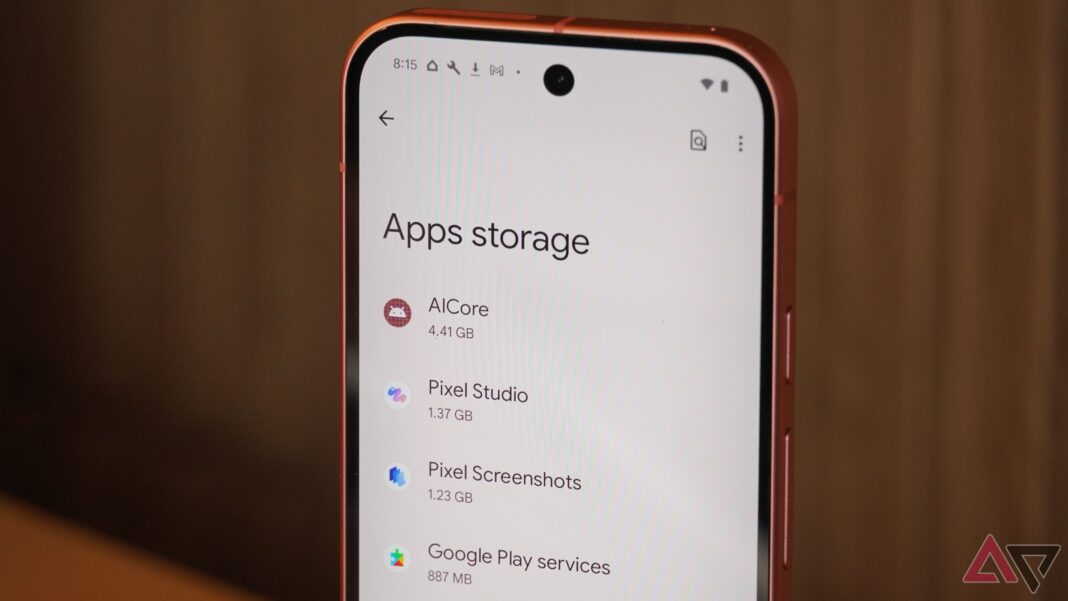


If you’ve popped the hood on your Android device’s storage settings lately, you might have noticed a new, somewhat mysterious occupant claiming a significant chunk of your flash memory: AICore. For years, we’ve been conditioned to track storage hogs like high-resolution video files, bloated social media caches, or the occasional runaway game update. But AICore represents a fundamental shift in the architecture of our mobile devices. It isn’t just another background process or a temporary cache; it is the physical manifestation of Google’s pivot toward On-Device AI. We are moving away from the era where your phone was merely a portal to the cloud, and toward a reality where your handset is a self-contained inference engine.
The Architecture of On-Device Intelligence
At its core, AICore acts as the system-level service that enables Android to run AI models locally. By moving the heavy lifting from Google’s massive data centers to your phone’s NPU (Neural Processing Unit), Google is attempting to solve the latency and privacy bottlenecks that have plagued generative AI since its inception. When you see that storage footprint expanding, you aren’t just looking at junk data; you’re looking at the weight of Large Language Models (LLMs) and diffusion models being pre-loaded to ensure that features like Gemini Nano can function without a ping to a remote server.
This is a significant departure from the “thin client” philosophy that dominated mobile computing for the last decade. Previously, if you wanted an AI to summarize a document or rewrite a text, that data had to travel across the internet, be processed, and return to you. With AICore, the models are persistent. They live in your storage, ready to be called upon by the operating system or third-party apps at a moment’s notice. It’s a bold bet on hardware capability, assuming that the average user’s flagship device has enough headroom to handle these resource-intensive weights without causing the system to stutter or the battery to crater.
The Trade-Off: Storage vs. Capability
For the power user, this raises an immediate, practical question: what are we sacrificing? As these AI models become more sophisticated, their file sizes grow proportionally. We are entering a phase where the “cost” of a smart phone isn’t just the sticker price at the retail store, but the actual physical storage space these models demand. If you’re rocking a base-model device with 128GB of storage, AICore isn’t just a background utility—it’s a major competitor for space against your 4K video library and your offline maps. It’s a classic tech trade-off: we are trading gigabytes of storage for the convenience of instant, private, and offline intelligence.
However, the upside is undeniable for those who prioritize privacy. Because these models are now baked into the device’s local storage, your sensitive data—the context for your emails, your voice memos, and your personal notes—doesn’t necessarily need to leave your device to be processed. This is a massive win for the “privacy-first” crowd, provided that the AICore implementation remains transparent. Google is betting that if they can make the AI experience fast enough and private enough, users won’t mind the storage tax. But as someone who has tracked the bloat of Android system partitions over the years, I have to wonder how long this “on-device” approach can scale before we hit a wall with mid-range hardware.
The Developer Ecosystem Shift
Beyond the user experience, AICore is effectively a new API surface for developers. By providing a standardized way to interact with on-device models, Google is lowering the barrier to entry for app creators. Instead of every developer having to bundle their own, potentially massive, AI models inside their individual APKs—which would lead to catastrophic storage redundancy—they can now tap into the shared models managed by AICore. This is a smart move for system efficiency, but it centralizes a massive amount of power in Google’s hands regarding which models are deemed “standard” for the Android ecosystem.
This transition changes how we view software updates. In the past, a system update brought new features or security patches. Now, a system update can effectively “upgrade” the intelligence of your phone by swapping out the model weights stored within AICore. We are moving toward a world where your phone’s personality and capabilities are fluid, updated through these model packages rather than just interface tweaks. It’s a fascinating, if slightly unsettling, evolution of mobile software management that puts the focus squarely on the inference capabilities of the silicon inside your pocket.
The Hardware-Software Symbiosis: Why Your NPU Matters
The expansion of AICore isn’t happening in a vacuum; it is tethered directly to the evolution of the System-on-Chip (SoC). For years, the NPU was a marketing checkbox—a component that sat largely idle unless you were applying a specific beauty filter in the camera app. Today, AICore is effectively the “driver” that allows the operating system to treat the NPU as a primary resource, much like the GPU handles graphics or the CPU manages general logic. By standardizing how these models interact with the silicon, Google is reducing the overhead that previously made on-device inference a battery-draining nightmare.
However, this transition creates a new hierarchy of device capability. We are quickly approaching a point where the amount of LPDDR5X RAM and the specific throughput of your storage controller will dictate the quality of your AI experience. If your device lacks the necessary bandwidth to load these AICore models into memory quickly, the “instant” response we expect from Gemini Nano will stutter. Below is a breakdown of how the hardware tiers are beginning to diverge in the age of persistent local models: For more on this topic, see: Prime Video Just Changed Everything .
| Hardware Component | Role in AICore Performance | Bottleneck Risk |
|---|---|---|
| NPU (Neural Processing Unit) | Executes tensor operations locally | High (Low TOPS limit model complexity) |
| UFS 4.0 Storage | Loads model weights into RAM | Medium (Read speed determines latency) |
| System RAM | Maintains active model state | Critical (Insufficient RAM triggers swapping) |
The Privacy Paradigm Shift
The most compelling argument for the growth of AICore is the containment of personal data. By shifting the inference engine to your local hardware, Google is effectively creating a “sandbox” for your most sensitive inputs. When you ask your phone to summarize a private email or analyze a drafted document, that data no longer needs to traverse the web. This is a massive win for data sovereignty. By keeping the model weights on the device and the data processing within the local memory, the attack surface for potential data interception is significantly reduced.
However, this convenience comes with a trade-off: the “black box” nature of these models. While we know AICore is managing these models, the average user has little visibility into which specific parameters are being tuned or what data is being used for federated learning updates. As these local models become more capable, the transparency of how they interact with our personal information will become the next major battleground for privacy advocates and regulators alike. For more information on how Google approaches these standards, you can review the official Android AICore developer documentation or the broader Google AI Principles. For more on this topic, see: Google Play System Update Just . For more on this topic, see: Sleek New Android Phone Comes .
The Future of Persistent Local Intelligence
Looking ahead, the footprint of AICore is only going to grow. We are moving toward a modular AI ecosystem where you might soon download “model packs” for specific tasks—one for advanced image editing, another for real-time translation, and a third for complex coding tasks. This will turn our phones into specialized workstations that are no longer dependent on the reliability of a cellular connection. The storage you see being consumed today is essentially the “foundation” for a far more capable mobile OS.
For the power user, this is an exciting time. We are finally seeing the realization of the “mobile supercomputer” promise that was made over a decade ago. While the storage usage might feel like a tax on your device today, it is actually a down payment on a more responsive, private, and capable device tomorrow. The challenge for Google will be optimization—ensuring that these models remain efficient enough to fit into the constraints of mobile hardware without requiring the user to constantly purge their photos or apps to make room. If they can balance this, the mobile device will cease to be a tool that connects us to intelligence and instead become a vessel for intelligence itself.
Ultimately, the rise of AICore signals that the “Cloud-First” era of mobile computing is waning. We are entering the age of Edge Intelligence, where the value of your phone is measured not just by its screen resolution or camera sensor, but by the sophistication of the models it can run while offline. Keep an eye on those storage settings; in the coming months, they will tell the story of your device’s evolution from a simple communication tool to a truly autonomous digital assistant. For technical specifications on the underlying framework, you can refer to the official Android platform overview.