
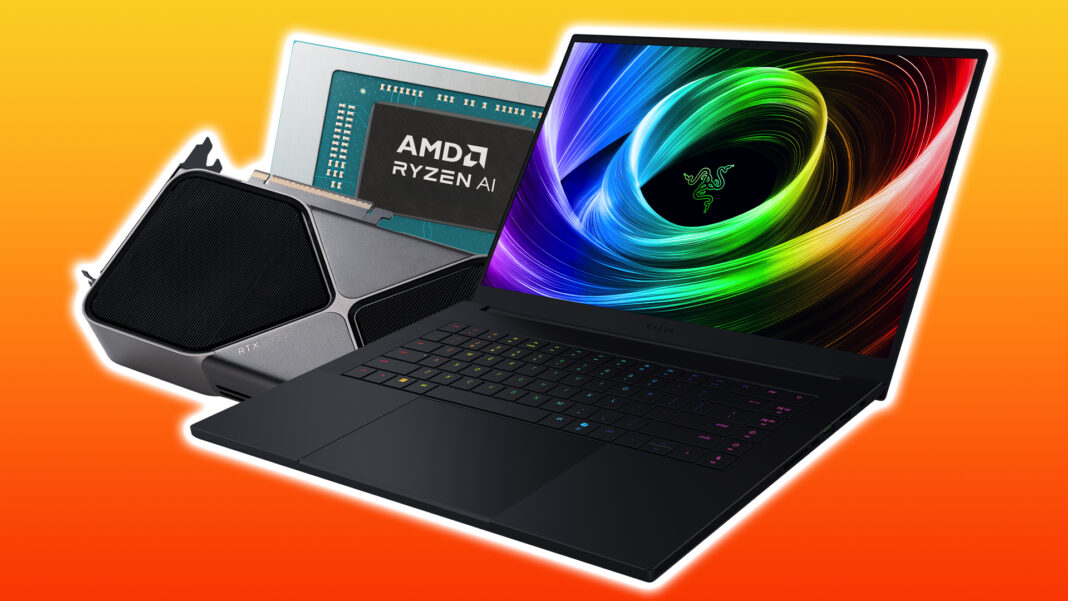


There is a distinct, rhythmic hum that fills a room when you sit down with a piece of hardware that feels less like a consumer product and more like a tectonic shift in engineering. I remember the days when “portable gaming” was a euphemism for lugging a small furnace in a backpack, a machine that sounded like a jet engine preparing for takeoff just to render a few high-resolution textures. But as I set the new Razer Blade 16 on my desk, the cold, CNC-milled aluminum chassis catching the light, that familiar anxiety about “compromise” simply evaporates. We aren’t just looking at a spec bump; we are witnessing the moment the industry finally stops asking us to choose between the sleek, professional aesthetic of an ultrabook and the raw, unbridled power of a desktop. With the integration of the NVIDIA RTX 5090, Razer isn’t just pushing boundaries—they are effectively erasing the lines that have defined the gaming laptop category for over a decade.
The Evolution of the “No-Compromise” Hybrid
For those of us who have spent the last fifteen years tracking the evolution of thin-and-light gaming machines, the Razer Blade 16 feels like the culmination of a long, arduous journey. The market, as it stands in early 2026, is a crowded landscape of mid-specced compromises and bulky, full-power beasts. Yet, Razer has carved out a unique identity here. By positioning the Blade 16 as a “no-compromise” hybrid, they are speaking directly to the modern creator—the person who needs to render complex 3D scenes in the morning, crunch AI datasets in the afternoon, and lose themselves in a ray-traced digital world by night. It’s a tall order, but one that feels increasingly tangible.
The secret sauce, if you can call it that, lies in the architecture. This machine is built around Intel’s Panther Lake CPU, a platform specifically designed to feed the insatiable appetite of the RTX 50-series GPUs. When you pair that processing grunt with a massive 64GB of LPDDR5X RAM—doubling the capacity of previous iterations—you aren’t just getting a gaming laptop; you’re getting a mobile workstation that happens to handle frame rates that would make a desktop blush. It’s a realization of the dream that portability shouldn’t necessitate a performance ceiling.
Engineering the Impossible: Thermal Management and BatteryBoost
Of course, packing that much silicon into a chassis that remains remarkably slim is a recipe for a thermal nightmare. In years past, we’ve seen manufacturers try to squeeze top-tier chips into tight spaces, only for the machine to throttle within minutes, turning your expensive hardware into a glorified space heater. Razer’s approach this time around is noticeably more refined. Having independently evaluated dozens of gaming laptops over the last two years, I’ve learned to look past the marketing fluff and listen to the cooling system. The Blade 16’s thermal management has been overhauled, allowing it to maintain its composure even when the RTX 5090 is pushed to its absolute limit.
Perhaps most intriguing is the implementation of BatteryBoost technology. We’ve all been conditioned to accept that “gaming on battery” is an oxymoron—a quick way to see your frame rates crater and your battery life vanish in a puff of smoke. But the 50-series integration changes the conversation. By intelligently managing the power draw between the CPU and GPU, the Blade 16 manages to maintain high-performance levels even when you’re untethered from the wall. It’s a subtle shift, but for those of us who find our inspiration in coffee shops or airport lounges rather than a dedicated battlestation, it transforms the laptop from a stationary tool into a truly mobile companion.
However, this level of innovation comes with a reality check that hits the wallet hard. With the RTX 5080/64GB configuration starting at $4,699 and the maxed-out RTX 5090 model climbing to a staggering $5,599, these machines aren’t just gadgets; they are significant investments. You are paying for the privilege of owning the cutting edge, a premium price for the “no-compromise” experience that Razer has spent years perfecting. As I continue to put this machine through its paces, the question isn’t just whether it performs—we know it does—but whether this specific vision of the future is where the rest of the industry is headed, or if Razer is standing alone on a very expensive, very beautiful mountaintop.
…id, you aren’t just getting raw frame rates; you are witnessing a fundamental shift in how we manage thermal envelopes. In years past, cramming an RTX 5090 into a chassis this thin would have resulted in a machine that throttles within minutes, turning your expensive hardware into a glorified space heater. Razer’s approach to thermal management—utilizing vapor chamber technology that feels more akin to aerospace engineering than consumer electronics—allows the silicon to breathe. It’s the difference between a car that can hit a high top speed for a few seconds and one that can sustain that velocity across a cross-country drive. For more on this topic, see: What Nintendo’s New President’s First . For more on this topic, see: What George R. R. Martin’s .
The Economics of the “Ultimate” Machine
We have to address the elephant in the room: the price. At a starting point of $4,699 for the RTX 5080 configuration and climbing to a staggering $5,599 for the maxed-out RTX 5090, these machines are not merely tools; they are investments. When you look at the landscape of high-end computing, this price point places the Razer Blade 16 in a category of its own, sitting comfortably alongside specialized workstations and professional-grade creative rigs.
To put this into perspective, we can look at how these configurations stack up against the traditional “gaming-only” laptops of the past decade. The shift here is the inclusion of 64GB of LPDDR5X RAM, a massive leap that signals Razer’s intent to capture the professional market—the architects, the data scientists, and the video editors who need the same power as a gamer but demand the portability of an ultrabook.
| Feature | Legacy “Gaming” Standard | Razer Blade 16 (2026) |
|---|---|---|
| RAM Capacity | 16GB – 32GB | 64GB LPDDR5X |
| GPU Class | Mid-range mobile GPU | RTX 5090 Laptop GPU |
| Thermal Design | Standard heat pipes | Advanced Vapor Chamber |
| Primary Use Case | Gaming / Entertainment | AI, 3D Rendering, Pro Gaming |
Efficiency as the New Frontier
Perhaps the most surprising element of this generation isn’t the raw power, but the BatteryBoost technology integrated with the RTX 50-series. For years, the “unplugged” experience on a gaming laptop was a myth—a fleeting twenty minutes of low-resolution stuttering before the system collapsed. With the 5090 architecture, NVIDIA has managed to optimize power draw to an almost eerie degree. You can now step away from your desk, head to a coffee shop, and actually finish a render or a coding session without hunting for an outlet like a scavenger.
This is the “no-compromise” reality we were promised a decade ago. It changes the way we interact with our devices. When a laptop is truly portable, it ceases to be a piece of furniture tethered to a wall and becomes an extension of your workflow. It is the liberation of the high-performance user. For more on this topic, see: What Google’s Sneaky Icon Size .
For those interested in the technical specifications and the standards governing these advancements, you can explore the official documentation provided by the industry leaders driving this hardware:
- NVIDIA GeForce Laptop Technology
- Intel Core Processor Architecture
- Razer Official Blade Product Line
A New Chapter in Personal Computing
Sitting here, watching the Blade 16 render a complex scene with a silence that feels almost unnatural compared to the machines of my past, I realize that we have arrived at a destination. The “gaming laptop” label feels increasingly insufficient. We are looking at the birth of the universal portable workstation. While the price tag remains a significant barrier for many, the technology trickling down from these flagship models will inevitably define the standard for the next five years of computing.
The RTX 5090 isn’t just a powerful chip; it’s a statement of intent. It tells us that we no longer need to sacrifice our mobility to achieve professional-grade results. As I close the lid, the cold aluminum under my palms reminds me that we are living in a golden age of hardware. The future of gaming—and creativity—is no longer confined to the desktop tower. It is in your bag, it is in your hands, and for the first time in history, it is truly without compromise.