
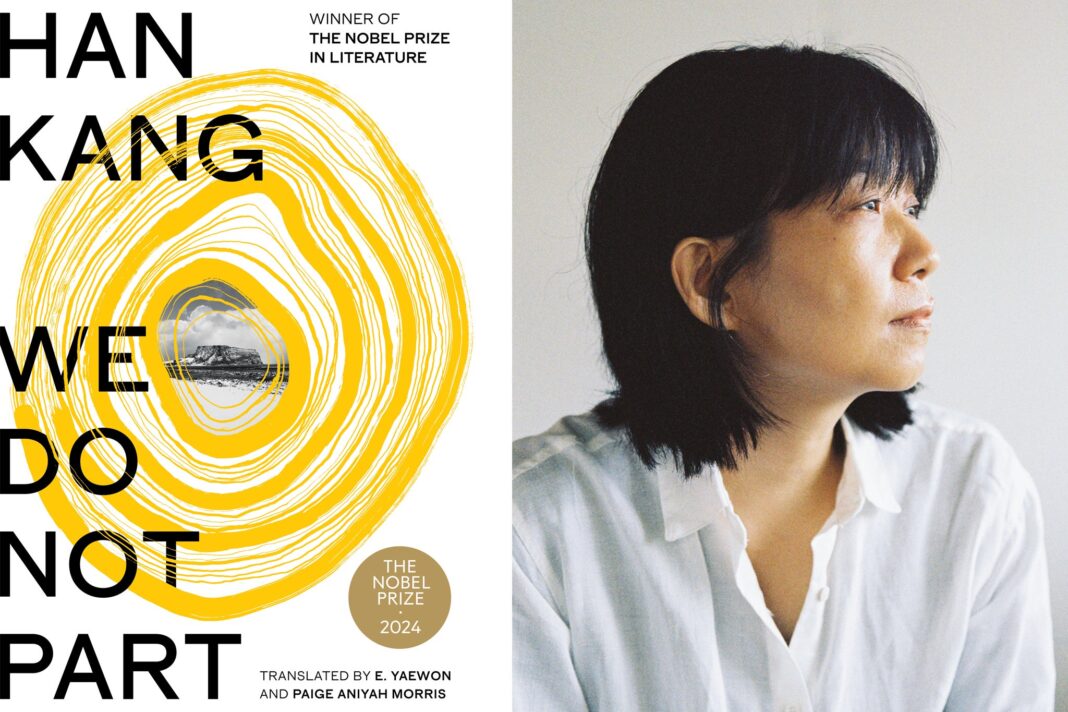


There is a particular kind of silence that hangs in the air when you open a book by Han Kang. It isn’t the empty, hollow silence of a room left vacant; it is a heavy, pressurized quiet—the kind that exists just before a thunderstorm breaks or in the wake of a profound, life-altering realization. For years, we have parsed her prose to understand the ghosts she exhumes: the historical traumas of Gwangju in Human Acts, or the surreal, visceral disintegration of the self in The Vegetarian. But with her latest foray into nonfiction, the veil is finally thinning. We aren’t just reading the story anymore; we are being invited into the workshop, standing over the shoulder of a master as she meticulously dismantles the mechanics of her own memory.
The Architecture of an Ache
To understand Han Kang is to understand that writing, for her, is not merely a profession; it is an act of archaeological excavation. In her new nonfiction work, she peels back the layers of her creative process to reveal a startling truth: her stories do not begin with a plot point or a character arc, but with a physical sensation—a specific, lingering ache. She describes the act of writing as a way of “asking questions” of the world, a relentless pursuit of answers that she knows, deep down, may never fully materialize. It is a vulnerable admission that strips away the myth of the “author as god” and replaces it with the image of a seeker, lost in the woods of her own imagination.
What strikes me most is how she treats language as a fragile, almost dangerous instrument. In these pages, she explores the tension between the limitations of words and the vast, chaotic reality of human suffering. She writes of the struggle to find the “right” sentence, not for the sake of aesthetic beauty, but for the sake of ethical accuracy. For Han, the process is a moral burden. She isn’t just weaving a narrative; she is attempting to translate the silence of the dead and the unspoken grief of the living into something that can be held, read, and eventually, understood. It is a heavy weight to carry, and seeing her grapple with the mechanics of that burden feels like watching a tightrope walker perform without a net.
The Alchemy of Memory and Myth
One of the most fascinating revelations in this new collection is how Han Kang navigates the blurred lines between autobiographical truth and the transformative power of fiction. She reveals that her creative process is essentially an act of alchemy—taking the raw, jagged edges of her own memories and refining them through the fire of narrative. She doesn’t shy away from the fact that her personal history serves as the bedrock for her most harrowing scenes. By documenting her own internal landscape, she shows us that the “creative process” is not a linear path from A to B, but a recursive loop where the author is constantly being reshaped by the very stories they are trying to tell.
This is where the human interest angle truly hits home. She speaks to the reader not as a lecturer, but as a fellow traveler who has spent far too much time staring into the abyss. She explains that the stories that haunt her—the ones that demand to be written—are often the ones she is most afraid to confront. It’s a relatable, if unsettling, sentiment. We all have those moments of quiet introspection where we wonder if our own stories are worth the telling, or if the act of articulating them somehow changes their meaning. Han Kang’s nonfiction suggests that the change is inevitable. Once you give a memory a voice, it no longer belongs solely to you; it becomes a piece of the collective human experience, a shared artifact of our resilience and our capacity for pain. For more on this topic, see: What Nintendo’s New President’s First .
As she details the rituals of her drafting process—the long periods of stillness, the sensory deprivation, the deliberate cultivation of a state where the subconscious can bleed into the conscious—you begin to see the cost of her work. It is an immersive, almost sacrificial creative life. She doesn’t just write about the human condition; she subjects herself to it, testing the limits of her own empathy until she finds the kernel of truth that makes a story pulse with life.
…trying to honor the weight of voices that have been silenced by history. She treats every adjective as a potential distortion, every metaphor as a bridge that might collapse under the weight of the truth it attempts to carry. It is a grueling, slow-motion labor, one that forces the reader to reconsider whether literature is a sanctuary or a mirror held up to our own complicity.
The Geography of Memory and Displacement
If her fiction is the house, her nonfiction is the blueprint, revealing the structural importance of geographical displacement. Han Kang’s process is inextricably linked to the landscapes she inhabits—the way a specific street in Seoul or the quiet isolation of a rural cabin dictates the rhythm of her sentences. She posits that memory is not a mental construct, but a physical space we inhabit. By documenting her own movements and the sensory triggers of her environment, she demonstrates how the “creative process” is often just a conversation between the writer’s body and the geography of their past. For more on this topic, see: NASA’s Latest Space Mission Just .
This approach highlights a fascinating contrast between her internal world and the external reality. Below, we can see how Han translates these abstract environmental influences into the concrete thematic pillars of her work:
| Environmental Trigger | Creative Translation | Literary Outcome |
|---|---|---|
| Urban Isolation | The fragmentation of the self | Surrealist character arcs |
| Historical Sites | The burden of collective memory | Political and social critique |
| Natural Stillness | The pursuit of sensory clarity | Minimalist, poetic prose |
For those interested in the broader context of the historical and cultural landscapes that inform such deep, reflective writing, the UNESCO World Heritage site provides an expansive look at how physical locations preserve human history, much like the way Han preserves the echoes of Gwangju in her own pages.
The Ethics of the “Unwritable”
Perhaps the most profound revelation in her nonfiction is her candid discussion of the unwritable. Han Kang suggests that there are corners of human experience—the deepest pits of grief or the most jagged edges of trauma—that language is fundamentally unequipped to hold. Her process, therefore, is not about “capturing” these experiences, but about circling them. She writes with the humility of someone who knows that the most important parts of the story are the gaps, the white space on the page, and the moments where she chooses to stop writing altogether.
This is a radical departure from the modern obsession with productivity and “content.” Han invites us to view the act of creation as an act of subtraction rather than addition. It is the art of knowing what to leave out, of respecting the dignity of the pain by refusing to over-explain it. This perspective aligns with the ethos found in the archives of the Nobel Prize organization, where the legacy of literature is often framed not by the volume of work produced, but by the depth of its engagement with the human condition.
A Final Reflection
Reading Han Kang’s reflections on her own work feels less like a literary analysis and more like witnessing a quiet, private transformation. She teaches us that to create is to be vulnerable—to strip away the armor of certainty and stand exposed before the questions that haunt us. Her nonfiction acts as a compass, not for where we are going, but for how we might better understand where we have been.
As I close the final pages of her latest work, I am left with a lingering sense of responsibility. Han does not offer us an easy path to catharsis; she offers us the tools to sit with our discomfort, to acknowledge the ghosts in our own histories, and to treat our own memories with the same rigorous, tender care she applies to her prose. Perhaps the most valuable lesson she imparts is that our own stories, however messy or fragmented they may seem, are worth the excavation. The silence she leaves us with isn’t empty anymore; it is full of the echoes of our own questions, finally beginning to find their shape. For more on this topic, see: What George R. R. Martin’s .
For more information on the cultural context of Korean literature, you can explore the Korea Citation Index, which serves as a repository for academic discourse on the evolution of contemporary narratives in the region.