
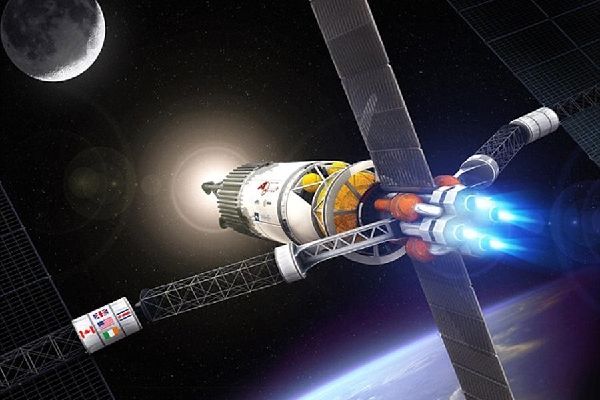


If you’ve been tracking the evolution of deep space exploration, you know the biggest bottleneck has never been our ambition—it’s been the physics of the fuel tank. We’ve spent decades relying on chemical propulsion, which is essentially the space-faring equivalent of trying to drive across the country while carrying your entire fuel supply in a series of volatile, heavy explosions. But NASA’s recent breakthrough at the Jet Propulsion Laboratory (JPL) suggests we are finally moving past the era of brute-force combustion. By successfully firing a new magnetoplasmadynamic (MPD) thruster powered by lithium metal vapor, engineers have hit a record-breaking 120 kilowatts of power. This isn’t just an incremental upgrade; it’s a fundamental shift in how we intend to push humans toward Mars.
The Power of Lithium: Rethinking Electric Propulsion
To understand why this test on February 24, 2026, is making waves in the aerospace community, you have to look at the limitations of our current fleet. The Psyche mission, which is currently navigating the asteroid belt, uses state-of-the-art electric thrusters. They are marvels of efficiency, but they are relatively low-power devices. NASA’s new prototype is operating at a scale that dwarfs existing hardware, generating over 25 times the power of the thrusters currently propelling the Psyche spacecraft. When you’re talking about moving heavy life-support systems, radiation shielding, and human crews, “more power” is the only variable that truly matters.
The secret sauce here is the propellant: lithium metal vapor. Most electric propulsion systems rely on noble gases like xenon, which are incredibly expensive and notoriously difficult to source in the quantities required for long-duration, high-thrust missions. Lithium, by contrast, is far more abundant and, when vaporized and accelerated through an electromagnetic field, provides the high-density exhaust velocity needed to move massive payloads through the vacuum of space. It’s a clever bit of engineering that trades the complexity of gas storage for the raw, high-energy potential of a metal-vapor plasma.
Engineering the Impossible: Heat and Infrastructure
Pushing 120 kilowatts through an engine isn’t as simple as turning a dial; it creates a thermal environment that would liquefy standard aerospace components. During the recent test at JPL, the thruster’s internal tungsten electrode reached temperatures exceeding 5,000 degrees Fahrenheit. Managing that kind of heat requires more than just clever software or durable materials; it requires a massive support infrastructure. The team had to utilize a specialized, 26-foot-long water-cooled vacuum chamber just to keep the test rig from vaporizing itself along with the fuel.
This level of intensity is exactly what we need for the next generation of nuclear electric propulsion. While chemical rockets are excellent for the violent, high-thrust demands of escaping Earth’s gravity well, they are notoriously inefficient for the long, steady haul of interplanetary transit. Electric propulsion systems can utilize up to 90% less propellant than their chemical counterparts. By pairing high-power MPD thrusters with a nuclear reactor—which provides the steady, high-wattage electricity required to keep the plasma accelerating—NASA is effectively building a “space tug” capable of carrying heavy, crewed habitats to the Red Planet in a fraction of the time current transit windows allow.
Of course, building a test rig in a lab is one thing; deploying a nuclear-powered, lithium-fed engine in deep space is an entirely different technical hurdle. The integration of high-voltage power electronics with volatile metal-vapor propellants introduces a new set of failure modes that engineers are currently scrambling to model. We’re looking at a future where the primary constraint on our exploration isn’t the fuel we can carry, but the power we can generate.
Engineering the Impossible: Thermal Management and Electrode Longevity
Achieving 120 kilowatts of power is one thing; keeping the hardware from vaporizing itself is quite another. During the recent testing at the Jet Propulsion Laboratory, the thruster’s internal tungsten electrode reached temperatures exceeding 5,000 degrees Fahrenheit. Managing this level of thermal intensity requires more than just clever heat sinking; it necessitates a fundamental rethink of material science in vacuum environments.
To facilitate this test, NASA utilized a specialized 26-foot-long water-cooled vacuum chamber. In a flight scenario, we don’t have the luxury of external water cooling systems. This is where the transition from laboratory prototype to flight-ready hardware becomes the primary engineering hurdle. We are effectively looking at the birth of Nuclear Electric Propulsion (NEP) architectures, where a small-scale fission reactor provides the continuous electrical load required to keep the lithium vaporizing and the electromagnetic fields active. The synergy between high-output power generation and high-thrust electric propulsion is the “holy grail” for reducing transit times to the Red Planet.
For those interested in the technical specifications and the broader context of how these systems compare to traditional methods, the following table breaks down the efficiency gap:
| Propulsion Type | Propellant Efficiency | Primary Use Case |
|---|---|---|
| Chemical Rockets | Low (High Thrust, Short Duration) | Launch/Escape Velocity |
| Xenon-based Ion | High (Low Thrust, Long Duration) | Deep Space Probes |
| Lithium MPD | Very High (High Thrust, Long Duration) | Crewed Interplanetary Transport |
The Shift Toward Sustainable Interplanetary Logistics
Beyond the raw physics, there is a logistical revolution occurring here. Xenon, the current industry standard for ion propulsion, is a noble gas derived as a byproduct of liquid oxygen and nitrogen production. It is rare, expensive, and difficult to store in the massive quantities required for a crewed Mars mission. Lithium, by contrast, is a solid at room temperature and represents a much more manageable logistical profile. By switching to a metal vapor, we aren’t just improving thrust-to-power ratios; we are creating a supply chain that is more resilient and scalable. For more on this topic, see: Breaking: BlackRock Chief Demands Radical . For more on this topic, see: What Ubisoft’s cryptic tweet revealed .
This shift allows us to move away from the “disposable spacecraft” paradigm. If we can master high-power lithium propulsion, we can build propulsion buses—spacecraft that remain in orbit between Earth and Mars, ferrying supplies and crews back and forth rather than being discarded after a single trajectory. This is the difference between a one-off expedition and a permanent presence in the solar system.
For official documentation on the ongoing research into these propulsion systems and the broader goals of deep space exploration, you can review the following resources:
- NASA Jet Propulsion Laboratory Official Site
- NASA Psyche Mission Overview
- NASA Space Technology Propulsion Research
A New Trajectory for Human Exploration
We are currently in a transition phase where the limitations of our fuel are finally being acknowledged as a solvable engineering problem rather than an immutable law of nature. The 120-kilowatt test is a signal that the “brute force” era of chemical rockets is reaching its sunset for deep space transit. While chemical engines will always be necessary to punch through the thick soup of Earth’s atmosphere, the long, quiet, and efficient burn of a lithium-fed MPD thruster is what will actually get us to the surface of Mars with our health—and our budgets—intact.
The engineering challenges ahead are significant, particularly concerning the degradation of electrodes under sustained high-power loads. However, the data collected from this 2026 milestone proves that we have the capability to scale electric propulsion to the levels needed for human transit. We are no longer just dreaming of Mars; we are building the engine that makes the trip a matter of routine logistics rather than a heroic, once-in-a-generation gamble. The future of space travel isn’t about bigger explosions; it’s about better, more efficient ways to harness electricity to navigate the void. We’re finally on the right track. For more on this topic, see: NASA’s Latest Space Mission Just .