
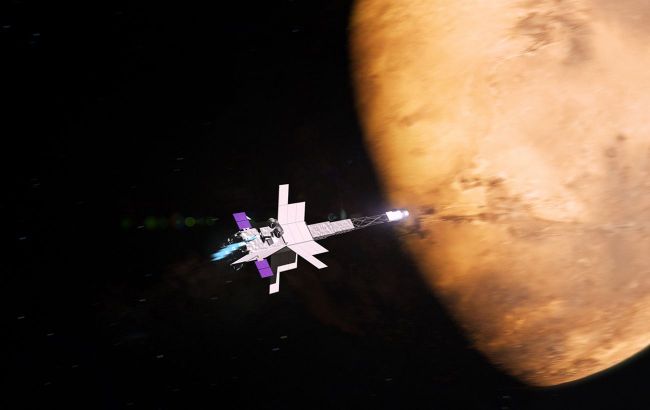


There is a specific kind of silence that exists in the vacuum of space, a cold, indifferent void that has humbled humanity since we first looked up and dared to dream of walking among the stars. For decades, our reach has been tethered by the limitations of chemical fuel—the explosive, heavy, and ultimately finite propellant that acts like a ball and chain on our interplanetary ambitions. But today, the narrative shifts. NASA has pulled back the curtain on the SR-1 Freedom mission, a project that doesn’t just promise to nudge the needle of progress; it aims to shatter the glass ceiling of deep-space travel with the raw, controlled fury of a nuclear heart.
The Atomic Engine: Harnessing the Power of Fission
At the center of this technological leap is Nuclear Electric Propulsion, a concept that sounds like it was ripped straight from the pages of a golden-age science fiction novel. Unlike the thrusters of the past, which rely on the violent combustion of chemical propellants, the SR-1 Freedom utilizes a fission reaction to generate electricity. This energy is then harnessed to ionize gas, transforming it into a high-velocity plasma jet. It is a process of elegant, terrifying efficiency that turns the very atom into our highway to the Red Planet.
The necessity for this shift is born from the harsh reality of the outer solar system. We have grown accustomed to the reliability of solar panels, but as any mission to the outer planets will tell you, the sun is a fickle companion. By the time a spacecraft drifts toward the orbit of Jupiter, the available solar energy drops to a mere 4% of what we enjoy here on Earth. The SR-1 Freedom bypasses this solar dependency entirely, offering a power source that is up to 10 times more powerful than conventional reactors and vastly more efficient than the chemical rockets that have served as our workhorses for half a century.
Forging Fire: The Lithium-Fed Breakthrough
The engineering behind this mission is nothing short of a masterclass in extreme physics. In recent tests, NASA successfully fired a lithium-fed magnetoplasmadynamic (MPD) thruster at a staggering 120 kilowatts. To put that into perspective, this is the highest power level ever achieved by an electric propulsion system on a U.S. spacecraft. It is a triumph of materials science, as the thruster’s tungsten electrode was pushed to thermal limits exceeding 5,000 degrees Fahrenheit—a temperature so intense it would liquefy nearly any other component in a standard engine.
The science is as fascinating as it is robust. By utilizing intense electric currents and magnetic fields to accelerate lithium vapor into a state of glowing plasma, the system creates a continuous, high-thrust output designed specifically for the grueling endurance of deep-space transit. During the testing phase, the thruster completed five successful ignition cycles. This wasn’t just a “one-and-done” laboratory curiosity; it was a demonstration of operational stability that proves we are finally ready to scale this technology for the long, lonely trek toward Mars.
The “Skyfall” Objective: Eyes on the Red Horizon
While the propulsion system itself is a marvel of human ingenuity, the true soul of the SR-1 Freedom lies in its destination. The primary objective of this mission is the delivery of the “Skyfall” project, an ambitious endeavor that seeks to change how we explore the Martian surface. Rather than relying on a single, vulnerable rover, the mission aims to deploy a fleet of three remotely operated helicopters. These aerial scouts will navigate the thin, dusty atmosphere of Mars, providing a perspective that ground-based vehicles simply cannot match. For more on this topic, see: Breaking: BlackRock Chief Demands Radical . For more on this topic, see: Breaking: $350 Mega-Pen Lamp Drops .
Imagine these three machines buzzing over the rusted dunes of the Valles Marineris, their rotors slicing through the Martian air as they transmit high-definition data back to a humanity waiting with bated breath. By pairing this revolutionary nuclear propulsion with the Skyfall fleet, NASA is effectively shrinking the solar system. We are moving away from the era of “can we get there?” and entering the era of “how much can we see once we arrive?” The leap from chemical rockets to nuclear-electric systems is the difference between rowing a boat across the Atlantic and boarding a jet—it is the moment we stop drifting and start driving. For more on this topic, see: Breaking: ASUS Unveils Revolutionary Holographic .
The Crucible of Innovation: Why Lithium?
The secret sauce behind the SR-1 Freedom’s record-breaking 120-kilowatt output isn’t just the fission reactor; it is the choice of propellant. By utilizing lithium vapor in a magnetoplasmadynamic (MPD) thruster, NASA engineers have moved beyond the limitations of xenon or argon, which have historically been the go-to propellants for ion drives. Lithium offers a unique combination of high atomic mass and low ionization energy, allowing for a level of thrust-to-power density that was previously confined to computer simulations.
The engineering challenges here are, quite frankly, staggering. To achieve this, the thruster’s tungsten electrode must endure temperatures exceeding 5,000 degrees Fahrenheit—a heat profile that would liquefy most conventional aerospace materials. Yet, the SR-1 has demonstrated remarkable stability across five ignition cycles. This isn’t just a lab experiment; it is the blueprint for a reliable, long-haul engine. For the engineers at the NASA Glenn Research Center, this success represents a triumph of materials science, proving that we can build machines capable of thriving in the most hostile environments imaginable.
Comparing the Propulsion Paradigms
To understand the magnitude of this shift, one must look at how the SR-1 Freedom stacks up against the legacy systems that have defined our spacefaring history. The leap from chemical combustion to nuclear-fed plasma is akin to the transition from the steam engine to the internal combustion engine—it changes not just how we travel, but where we can go and how long we can stay.
| Metric | Chemical Propulsion | Nuclear Electric Propulsion (SR-1) |
|---|---|---|
| Energy Source | Exothermic Chemical Reaction | Nuclear Fission |
| Efficiency | Low (High thrust, short duration) | High (Low thrust, continuous duration) |
| Deep Space Utility | Limited by fuel mass | High (Solar-independent) |
| Operational Life | Minutes/Hours | Years |
The Skyfall Objective: A New Era of Exploration
While the engine is the marvel that gets us there, the Skyfall project is the reason we are going. By carrying a fleet of three remotely operated helicopters, the SR-1 mission aims to redefine our presence on the Martian surface. These aren’t just mere scouting drones; they are sophisticated, long-range explorers capable of mapping the rugged, inaccessible terrain of the Valles Marineris. With the power provided by the nuclear core, the SR-1 acts as a mobile command hub, providing the high-bandwidth data relay necessary to operate these helicopters in real-time from orbit.
This mission represents a fundamental shift in our planetary strategy. Instead of landing a single, immobile rover that spends years crawling across a few kilometers of dust, we are effectively deploying an aerial task force. It is a bold, kinetic vision of exploration that mirrors the way we explore our own planet—with speed, agility, and a bird’s-eye view. You can learn more about the technical standards and regulatory framework for space nuclear power systems via the U.S. Department of Energy, which oversees the nuclear safety protocols essential to these missions.
As I look at the data coming out of the SR-1 testing, I am struck by the sheer human ambition required to make this a reality. We are a species that refuses to be constrained by the “impossible.” We have taken the raw, volatile power of the atom and bent it to the service of curiosity. The SR-1 Freedom is more than just a rocket; it is a testament to our stubborn refusal to stay grounded. When the mission finally departs, it won’t just be carrying fuel and hardware; it will be carrying the hopes of a generation that has finally decided to stop looking at the horizon and start moving toward it.
For those interested in the broader scientific context of planetary exploration and the history of these propulsion developments, the Wikipedia entry on Nuclear Propulsion provides a comprehensive overview of the physics involved. We are standing on the precipice of a new era, and for the first time in human history, the stars feel a little bit closer.