
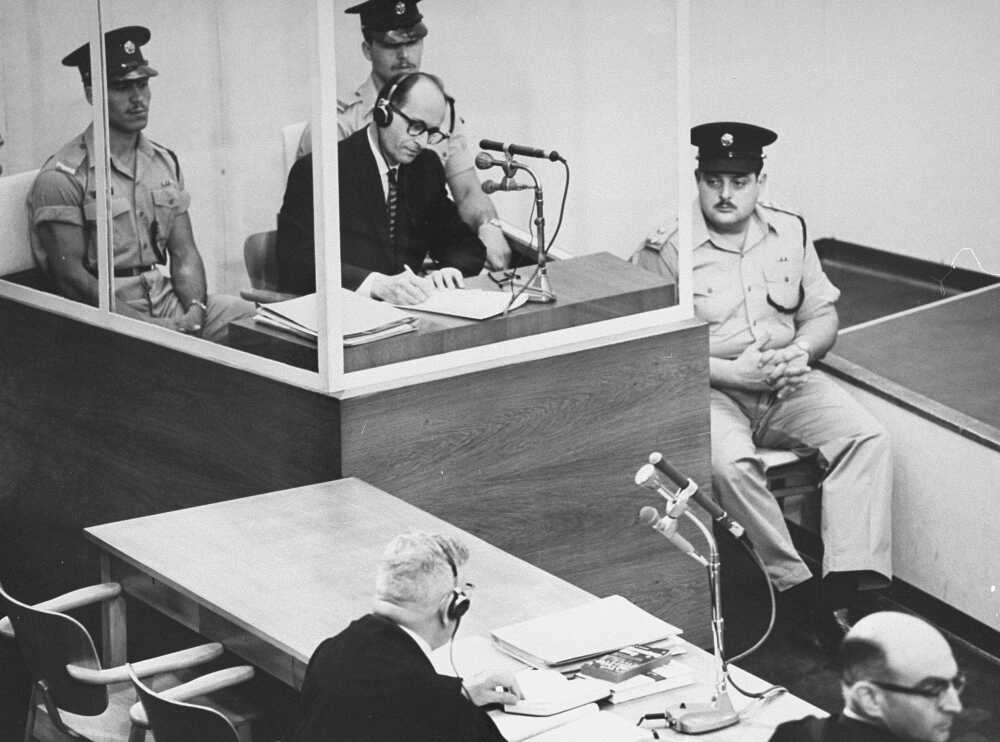


The glass booth sits in the center of the stage like a reliquary for a monster. For decades, our collective memory of the Adolf Eichmann trial has been locked in the grainy, flickering black-and-white footage of 1961—a clinical, haunting tableau of justice struggling to contain the sheer, suffocating weight of the Holocaust. We’ve seen the transcripts, we’ve read the philosophical dissections of the “banality of evil,” but we have rarely felt the claustrophobia of the room itself. A new drama, currently making waves in Jerusalem, is finally peeling back the layers of that bulletproof glass, demanding we look not just at the man sitting inside, but at the fragile, fractured humanity of the people tasked with judging him.
The Human Cost of the Witness Stand
There is a specific kind of silence that falls over a courtroom when the weight of history becomes too heavy to bear. In this new production, the focus shifts away from the high-minded legal maneuvering and lands squarely on the shoulders of the survivors who were summoned to testify. We are no longer watching a detached historical reenactment; we are watching a visceral, pulse-pounding exploration of what it means to articulate the inarticulable. The drama captures the trembling hands of a witness struggling to find words for a trauma that has no vocabulary, reminding us that for those in the gallery, this wasn’t a trial—it was a reopening of wounds that had barely begun to scar.
What makes this portrayal so startling is its refusal to paint the courtroom as a place of tidy resolution. Instead, the narrative leans into the friction between the Israeli prosecutors, who needed a coherent narrative to build a nation’s identity, and the survivors, whose memories were jagged, disjointed, and deeply personal. It’s a masterclass in tension, showing us that the trial wasn’t just about convicting a bureaucrat; it was a desperate, messy attempt to integrate the horror of the past into the bright, sun-drenched reality of a new state. By focusing on these human intersections, the play forces us to confront the reality that justice is rarely a clean process; it is a painful, grinding collision of lives.
The Architecture of a Monster
Then, there is the man in the booth. Eichmann has long been the subject of intense psychological scrutiny—Hannah Arendt’s famous “banality” thesis cast him as a cog in a machine, a man whose only crime was an inability to think. But this drama takes a more unsettling approach. By dramatizing the behind-the-scenes preparations of the defense and the prosecution, we see Eichmann not as a cartoon villain, nor merely as a faceless clerk, but as a man desperately curating his own image for posterity. The production captures the chilling banality of his movements—the way he adjusts his glasses, the way he takes notes—with a precision that makes your skin crawl.
The genius of this script lies in how it frames the Eichmann Trial as a piece of theater itself. We see the way the cameras were positioned, the way the lighting was adjusted to ensure the world saw exactly what the Israeli government wanted them to see. It’s a meta-commentary on the power of media, highlighting how this was the first televised war crimes trial in history. The drama posits that the trial was, in many ways, a performance designed to educate a global audience that had largely chosen to look away. Watching the characters grapple with the ethics of this “staging” is deeply provocative; it forces us to ask whether justice is truly served when it is also being performed for the cameras. For more on this topic, see: What George R. R. Martin’s .
As the narrative progresses, the lines between the hunters and the hunted begin to blur in ways that feel dangerously modern. We see the legal team wrestling with the moral implications of their own tactics, questioning whether the pursuit of a guilty verdict justifies the potential re-traumatization of an entire generation. It’s here that the story moves from a historical curiosity to a mirror for our own times, where the struggle for truth often feels just as precarious and contested as it did in that Jerusalem courtroom six decades ago. For more on this topic, see: What Nintendo’s New President’s First .
The Architect of Bureaucracy and the Myth of the Machine
For years, our understanding of Eichmann was filtered through the lens of Hannah Arendt’s seminal reporting, which famously characterized him as a cog in a machine—a man whose primary sin was a terrifying lack of imagination. This new theatrical interpretation, however, dares to dismantle that myth of the “unthinking clerk.” By placing the actor inside the glass booth for extended, uncomfortable durations, the production forces the audience to confront the active choices made within the silence of that enclosure. We see the subtle shifts in posture, the calculated gaze, and the flickers of ego that Arendt might have overlooked in her pursuit of a philosophical archetype. For more on this topic, see: This Ancient Aztec Whistle Just .
The drama highlights the tension between the image Eichmann projected—the meticulous, obedient servant—and the reality of his logistical machinations. By juxtaposing his calm demeanor with the raw, chaotic grief of the witnesses, the play illustrates that the “banality” was not an absence of intent, but a weaponized indifference. It forces us to ask: Is it more terrifying to believe that evil is a monstrous, supernatural force, or to accept that it is merely a choice made by a man who prefers a tidy spreadsheet to the sanctity of human life?
| Perspective | Primary Motivation | View of the Trial |
|---|---|---|
| The Prosecution | National Identity & Legal Precedent | A foundational pillar for a new state. |
| The Survivors | Testimony & Recognition | A painful reckoning with buried truth. |
| The Defendant | Self-Preservation & Bureaucratic Defense | A tactical battle for legal legitimacy. |
The Echoes of Justice in a Modern World
Perhaps the most haunting aspect of this production is its resonance with our contemporary era. We live in a time when the mechanisms of power are often obscured by digital screens and sanitized language. Just as the 1961 trial forced a generation to confront the physical reality of the Holocaust, this play forces us to confront the human cost of administrative detachment. When we distance ourselves from the consequences of our policies or our silence, we aren’t just observers; we are participants in a system that can be as cold and efficient as the one Eichmann managed.
The production subtly draws parallels to how we handle global atrocities today. It asks whether we have truly learned to recognize the “Eichmanns” in our own time—those who hide behind the guise of duty or the complexity of organizational structures. By stripping away the historical distance, the play transforms the courtroom into a mirror. We aren’t just looking at a man in a glass box; we are looking at the fragility of our own moral compasses when confronted with the pressure to conform.
For those interested in the historical record that grounds this dramatic interpretation, the following resources provide the essential context of the proceedings:
- trial” target=”blank” rel=”noopener”>Wikipedia: The Eichmann Trial – An overview of the historical timeline and the legal significance of the 1961 proceedings.
The Burden of Memory
As the final curtain falls, the silence in the theater is not one of relief, but of profound, unsettling weight. This drama succeeds because it refuses to offer the easy comfort of a historical period piece. It reminds us that memory is not a static object kept in a museum; it is a living, breathing, and often painful process that requires constant maintenance. The Eichmann trial was never meant to be the final word on the Holocaust; it was intended to be the beginning of a conversation that we are still, decades later, struggling to articulate.
We often look to history to find heroes and villains, hoping that clear-cut binaries will help us navigate our own moral landscapes. But this production leaves us with something far more complex: the realization that the shadows of 1961 are not behind us. They are cast long and deep into our present. By humanizing the trial—not by forgiving the monster, but by acknowledging the messy, fractured humanity of those who dared to stand against him—we are forced to carry that weight ourselves. The glass booth may be empty now, but the questions it contained remain, waiting for us to answer them with the same courage and clarity that the survivors of Jerusalem demanded of the world.